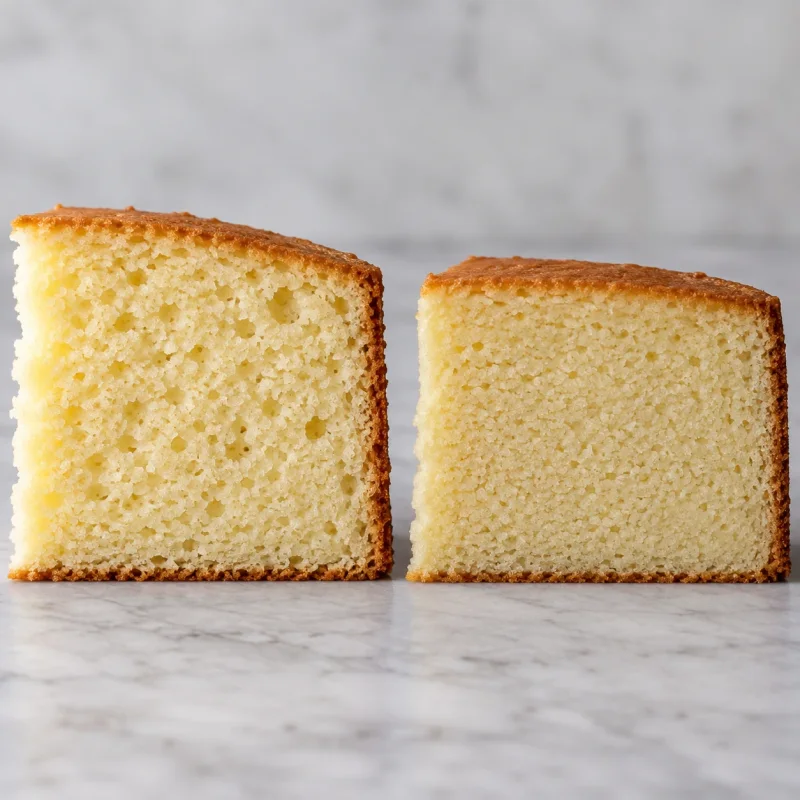
A cake is dense when the finished crumb is uniformly heavier, tighter, or lower-aeration than the recipe intends. The highest-value checks are the mixing method, ingredient temperature where the method depends on it, flour measurement, and leavener accuracy.
First confirm that the cake is meant to be light. Pound cake, some flourless cakes, cheesecakes, and other rich styles are intentionally compact. Density is a fault only when the result differs from the intended texture.
For mixed symptoms, use the cake troubleshooting guide.
Identify whether the cake was under-aerated or lost aeration
Different cake styles create air differently.
A classic creamed butter cake traps air during creaming. A sponge relies heavily on whipped eggs. A reverse-creamed cake deliberately produces a finer, tighter crumb. A stir-together oil cake may rely more on chemical leavening than on mechanical aeration.
The first question is therefore not "Did I overmix?" It is "Did I complete this recipe's aeration method correctly?"
Examples of failure include shortening a creaming step, deflating a foam while folding, or changing the order of mixing so the batter never develops the intended air-cell structure.
Ingredient temperature matters in creamed cakes
When a creamed recipe calls for properly softened butter and room-temperature eggs, those temperatures help the fat remain plastic and the emulsion stay stable.
Cold butter may not aerate effectively. Cold eggs can firm the butter and make the mixture look curdled or grainy, which can reduce the fine air network created during creaming.
This is not a rule that every cake ingredient must be warm. Follow the specific recipe. Temperature is most important when the mixing method depends on a stable fat-and-liquid emulsion.
Check flour measurement before changing the recipe
Too much flour shifts the balance toward more starch and protein relative to fat, sugar, eggs, and liquid. The batter can become thicker and the baked crumb firmer, drier, and more compact.
Use gram weights when they are provided. If the recipe was tested by weight, matching that weight is a cleaner diagnostic step than adding extra liquid to compensate for a cup measurement that may have packed in too much flour.
If the cake is both compact and noticeably dry, record both symptoms before changing the formula; excess flour can contribute to both.
Both under- and overmixing can matter
"Never overmix cake batter" is too simple to be useful across all cake styles.
King Arthur Baking has documented cases where undermixing left insufficiently developed structure and produced compressed, gummy lower layers. Other cake systems can become tough or gummy when mixing after flour addition is excessive.
Use the recipe's endpoint rather than a universal number of mixer revolutions. Scrape the bowl, make the batter homogeneous, and stop when the specified stage is reached.
If the crumb is sticky or gluey rather than simply compact, use the gummy cake diagnosis.
Check leavener quantity and condition
Too little active leavener can limit rise in cakes that depend on baking powder or baking soda. Incorrect measurement, substitution, or old product can therefore contribute to a heavy result.
Too much leavener is not the solution. Excessive gas production can create an unstable rise and later collapse, moving the failure toward the pattern described in why cake sinks in the middle.
Verify the recipe, measure accurately, and test or replace old leavener when there is a genuine reason to doubt it.
Do not use color alone to judge density
A dark crumb, moist crumb, or tight crumb is not automatically dense. Evaluate:
- overall cake height,
- cell size and distribution,
- whether the crumb is uniformly compact,
- whether a gummy band is localized,
- whether the center collapsed after a normal rise.
A dense cake is usually uniformly heavy. A gummy cake is sticky or compressed. A sunken cake shows a failure of height retention. Keeping those categories separate prevents contradictory fixes.
What you can do with a dense cake now
A fully baked dense cake cannot be made airy after baking because the missing or lost aeration is already fixed into the crumb. If the cake is pleasant and fully set, it can still be served in smaller portions or repurposed in a layered dessert where added moisture is intentional. If the crumb is sticky, paste-like, or visibly raw, do not treat density as the primary diagnosis; route the cake to the gummy or raw-center branch instead.
Causes, mechanisms, and fixes
| Cause | Mechanism | Matching fix |
|---|---|---|
| Incomplete aeration for the method | Too few stable air cells are created before the cake sets | Repeat the specified creaming, whipping, folding, or reverse-creaming endpoint |
| Excess flour or inaccurate measurement | More starch and protein relative to liquid and fat thickens the batter and tightens the baked crumb | Weigh flour and restore the tested ingredient balance |
| Leavener is weak or mismeasured | Gas production is insufficient or poorly timed for the structure the formula expects | Verify product type, freshness, and quantity rather than adding extra indiscriminately |
How to prevent a dense cake on the next bake
- Confirm the intended texture of the recipe.
- Repeat the specified aeration and mixing method exactly.
- Use the ingredient temperatures the method calls for.
- Weigh flour and major ingredients.
- Verify leavener measurement and condition.
- Use the specified pan and bake endpoint.
- Compare the cooled crumb from edge to center.
The goal is not maximum air. It is the amount and stability of aeration the recipe was designed to set into a tender crumb.
Problem solving
Symptoms, causes and corrections
Uniform compact crumb from edge to center
Likely cause: insufficient or lost aeration
What to do: Audit the recipe's aeration method, ingredient temperature, and mixing completion.
Heavy crumb plus excess flour by volume
Likely cause: measurement shift
What to do: Weigh flour and restore the tested formula before adding liquid.
Dense result in a cake intended to be tight-crumbed
Likely cause: possibly normal style
What to do: Compare with the intended crumb before correcting anything.