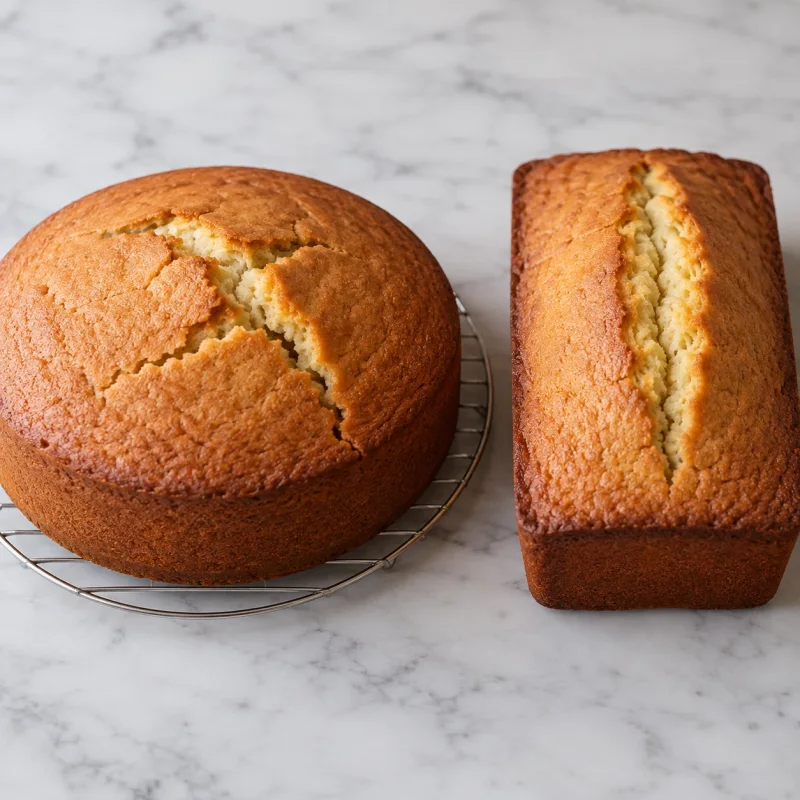
A cake cracks on top when the surface sets while the interior is still expanding enough to break through it. Whether that crack is a problem depends first on the cake style.
A central crack is normal and often desirable in many loaf and pound cakes. A deep irregular split is more useful as a troubleshooting signal when a recipe is intended to produce a relatively flat layer.
For the broader diagnostic map, use the cake troubleshooting guide.
First decide whether the crack is expected
Thick loaf and pound-cake batters commonly develop a central split. The exterior sets first; the interior keeps heating and expanding; the top opens where the crust is weakest.
King Arthur Baking even documents methods for deliberately controlling where a loaf cake cracks because a centered split is part of the expected appearance.
Do not "fix" a normal loaf-cake crack by changing temperature or leavening unless the finished crumb also shows a genuine defect.
In a layer cake, examine the heat pattern
A layer cake that should finish relatively flat deserves closer inspection when it has a large, irregular surface split.
Check:
- whether the oven runs hotter than its setting,
- whether the cake was baked unusually close to a strong heating element,
- whether the pan is smaller than specified,
- whether the batter layer is deeper than intended,
- whether a dark pan browned and set the exterior early.
These variables can cause the outside and top to firm while the center is still rising.
Crack plus dome is stronger evidence than a crack alone
A split across a pronounced raised center points toward the same edge-to-center setting imbalance that causes doming.
Use the cake doming guide when the center is clearly higher than the perimeter. Correcting the pan and heat pattern can reduce both symptoms without changing the ingredient formula.
A flat loaf cake with a neat central crack, by contrast, may need no correction at all.
Batter depth can increase the difference between surface and center
Moving the recipe to a smaller pan or filling the pan more deeply changes how long the center remains expandable.
The outer cake can become structurally firm while the middle is still rising. If you changed pan size, return to the intended capacity before changing leavener or flour.
If the deep center is also wet, the more urgent issue is doneness rather than the crack itself.
Do not use dryness as a diagnosis from the surface alone
A cracked top can look dry while the interior remains tender. Evaluate the cooled crumb before deciding that the entire cake was overbaked.
If the full crumb is dry or coarse, use the guide to why cake is dry to check flour, total bake exposure, oven temperature, pan changes, and substitutions.
Surface appearance alone cannot diagnose whole-cake moisture.
Review leavener only when expansion itself looks abnormal
Too much leavener can create aggressive expansion, but it should not be the default explanation for every crack.
Leavener measurement becomes more relevant when the cake rose unusually fast or high, developed a coarse crumb, or later collapsed. If the rise was otherwise normal and the crack sits on a high center, the heat and pan pattern is usually the cleaner first test.
What you can do with a cracked cake now
If the cake is a loaf or pound cake and the crumb is fully baked, a centered crack may require no rescue at all. If a layer cake is fully baked but has an unwanted surface split, cool it completely and level or cover the surface only as needed for assembly. A crack paired with a wet center, aggressive dome, or collapse should be treated as evidence of the underlying heat or structure problem, not merely hidden with frosting.
Causes, mechanisms, and fixes
| Cause | Mechanism | Matching fix |
|---|---|---|
| Expected loaf-cake expansion | A thick batter continues rising after the exterior has set, opening a central seam | Accept the crack when it matches the intended cake style |
| Layer cake sets too early at the surface | The center continues expanding beneath a firm top and forces an irregular split | Verify oven heat, rack position, pan size, and batter depth |
| Dome and crack develop together | Uneven edge-to-center setting concentrates late expansion in the raised middle | Correct the same heat-gradient variables used in the dome diagnosis |
How to prevent unwanted cracks on the next bake
- Compare the crack with the expected appearance of that cake style.
- Verify oven temperature if the defect repeats.
- Use the intended pan size and batter amount.
- Check whether the surface or edges browned unusually early.
- Bake on the intended rack.
- Diagnose a simultaneous dome as an uneven-setting problem.
- Keep the original formula while testing equipment and heat variables.
The correct target is not a universally smooth top. It is a surface that matches the cake style while the crumb remains fully set, tender, and structurally stable.
Problem solving
Symptoms, causes and corrections
Centered crack in loaf or pound cake
Likely cause: often style-appropriate expansion
What to do: Do not correct unless the recipe/result indicates a separate defect.
Deep crack across a domed layer cake
Likely cause: surface/edge set before center expansion finished
What to do: Check oven heat, pan color, batter depth, and doming.
Crack without dry crumb or dome
Likely cause: surface symptom alone is insufficient
What to do: Use cake style and crumb evidence before diagnosing heat or leavener.