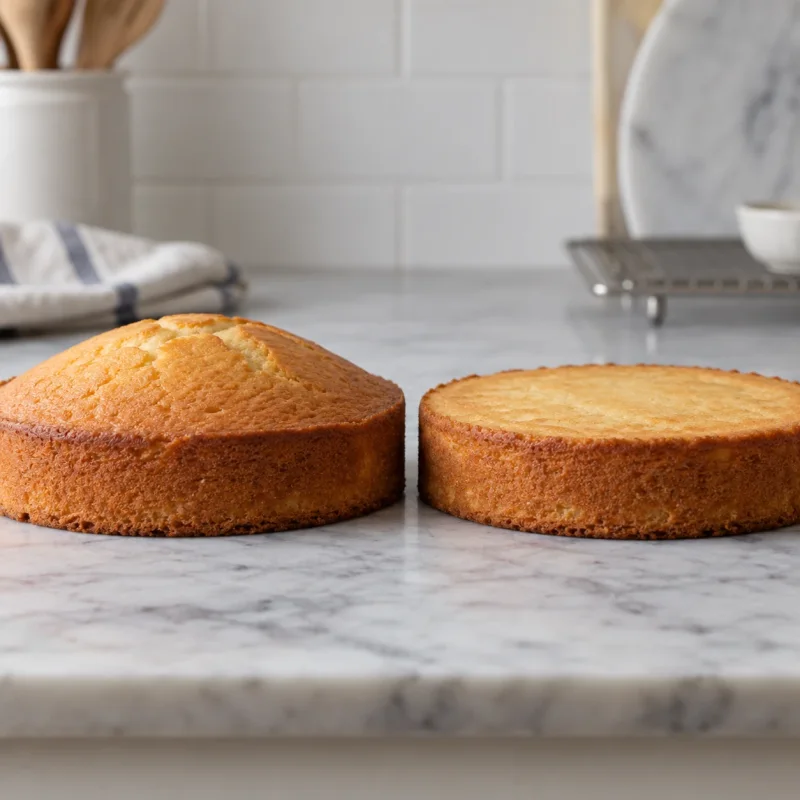
A layer cake domes when the edges set before the center has finished expanding. The perimeter becomes firm first, while the center remains able to rise, so the finished layer is higher in the middle.
For cakes that are intended to stack flat, diagnose edge-to-center heat balance, pan characteristics, and batter depth before changing the leavener.
For other failure patterns, use the cake troubleshooting guide.
Excessive edge heating is the central mechanism
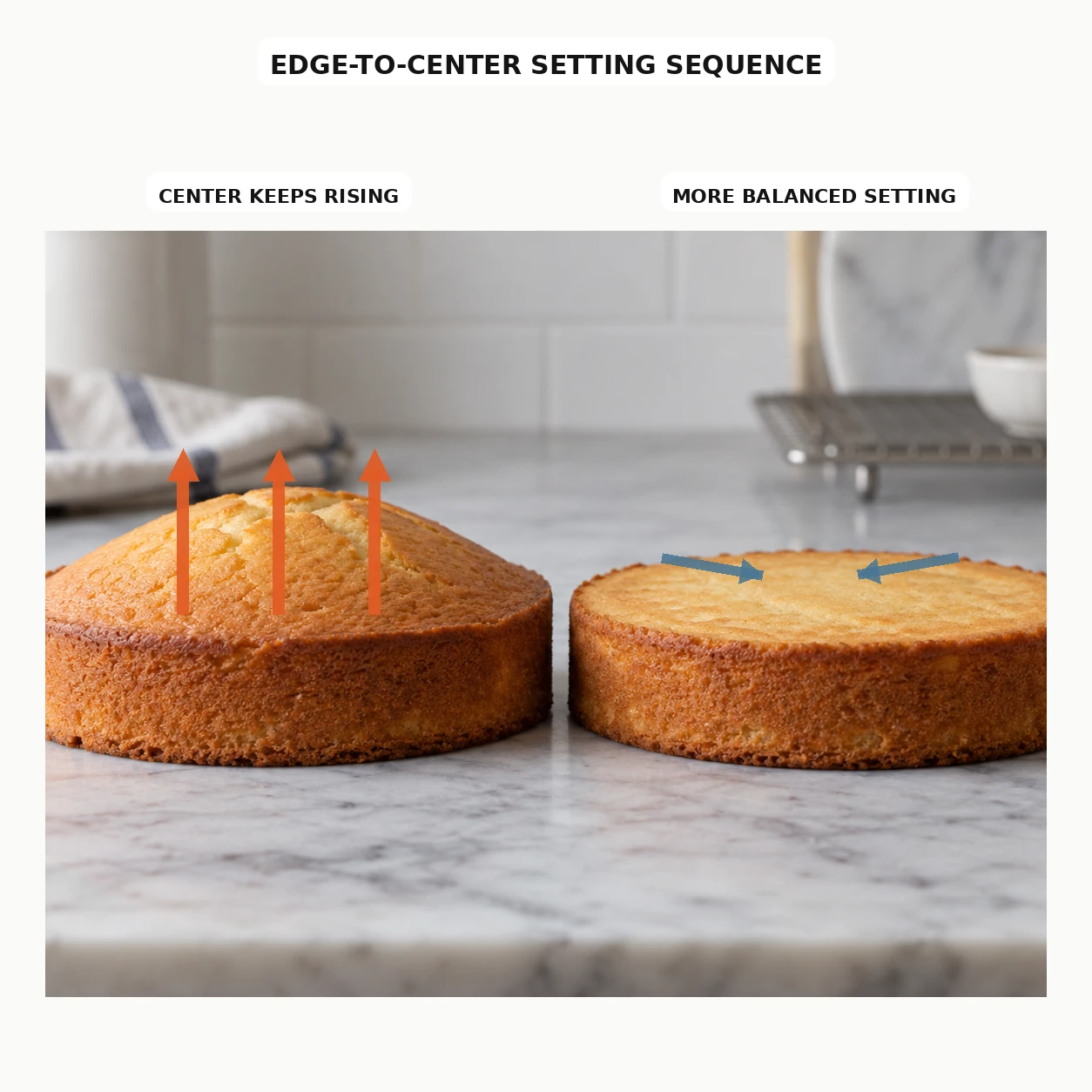
King Arthur Baking's even-baking tests show the basic pattern clearly: batter near the pan edge heats and sets earlier, while the slower-heating center continues to rise.
An oven that is hotter than the recipe expects can exaggerate this difference. Verify actual temperature if doming occurs across several recipes or if the edges consistently brown early.
The aim is not to stop the cake from rising. It is to reduce the timing gap between the edge setting and the center setting.
Dark pans can intensify the gradient
Dark metal absorbs heat more aggressively than light-colored metal. King Arthur's dark-pan testing shows that the sidewalls can set early while the center remains fluid and continues rising, producing a pronounced dome.
If the recipe was developed in light-colored aluminum, a very dark pan is a meaningful change.
Return to the specified pan while troubleshooting. If you keep the dark pan, treat any temperature adjustment as a controlled test for that equipment rather than a universal rule.
Batter depth changes the geometry
A deeper layer gives heat farther to travel before the center sets.
Using a smaller pan, overfilling a pan, or combining batter intended for several layers into one deeper layer can increase doming and lengthen the time needed for the center.
If the center is also visibly wet, the problem has crossed into doneness; use the guide to cake that is raw in the middle.
Cake strips work by slowing the edge
Damp cake strips insulate the outside of the pan so the edge heats more slowly. In controlled comparisons, King Arthur found that strips produced flatter layers and reduced overbaking at the perimeter.
They are useful when flat layer cakes are the goal, but they should not be the first response to an incorrect pan size or an oven that is running too hot.
Control the basic variables first; then test strips if the recipe and pan still produce an unwanted dome.
Do not reduce baking powder automatically
Too much leavener can create excessive rise and instability, but a stable cake with a smooth, consistent center dome often points more directly to the baking geometry.
If the cake has an even crumb, no collapse, and a repeatable raised center, check oven temperature, pan color, and batter depth before editing the formula.
If the cake rises dramatically and then falls, that is a different collapse pattern even though it may briefly look domed while baking.
Dome plus crack is a useful combined clue
When a high center is crossed by a split surface, the cake shows two signs that the outer structure set while the center continued expanding.
Use the guide to cake that cracks on top to determine whether the crack is expected for the cake style or part of the same uneven-setting pattern.
What you can do with a domed cake now
If the layer is fully baked and the dome is the only problem, let it cool completely before leveling it with a serrated knife or cake leveler for stacking. Do not press a hot cake flat: compression changes the crumb without correcting the heat pattern that created the dome. If the high center is also wet or split, treat the raw-center or crack as additional diagnostic evidence rather than a cosmetic problem.
A dome is not always a defect
A rounded top can be normal in muffins, loaf cakes, and other formats where a high center is part of the intended shape. The troubleshooting target here is a layer cake intended to stack relatively flat. Diagnose the recipe's expected geometry before changing temperature, leavener, or pan equipment.
Causes, mechanisms, and fixes
| Cause | Mechanism | Matching fix |
|---|---|---|
| Edges heat and set too quickly | The perimeter stops expanding while the still-fluid center continues to rise | Verify oven temperature and compare pan color/material with the recipe |
| Batter layer is too deep | The center needs longer to set, increasing the timing gap between middle and edge | Use the specified pan size and divide batter as directed |
| Edge insulation is insufficient for the desired flat layer | Sidewalls receive heat faster than the center and lock the perimeter early | After basic variables are correct, test properly used cake strips if appropriate |
How to prevent domed cake layers on the next bake
- Verify oven temperature.
- Use the pan size and batter quantity specified by the recipe.
- Compare your pan color and material with the intended equipment.
- Divide batter accurately between layer pans.
- Bake on the intended rack.
- If the basic variables are correct, test properly soaked cake strips.
- Change one factor per repeat bake.
A flatter layer comes from more synchronized setting from edge to center, not from suppressing the cake's intended rise.
Problem solving
Symptoms, causes and corrections
High center with lower, well-set edges
Likely cause: edges set before center finished expanding
What to do: Check oven heat, pan color, batter depth, and cake strips.
Dome is stronger in a dark pan
Likely cause: aggressive edge heating
What to do: Use the intended lighter pan or apply the recipe's dark-pan adjustment.
Dome plus deep surface crack
Likely cause: strong edge/surface setting while center continues expanding
What to do: Correct heat and geometry before changing leavener.