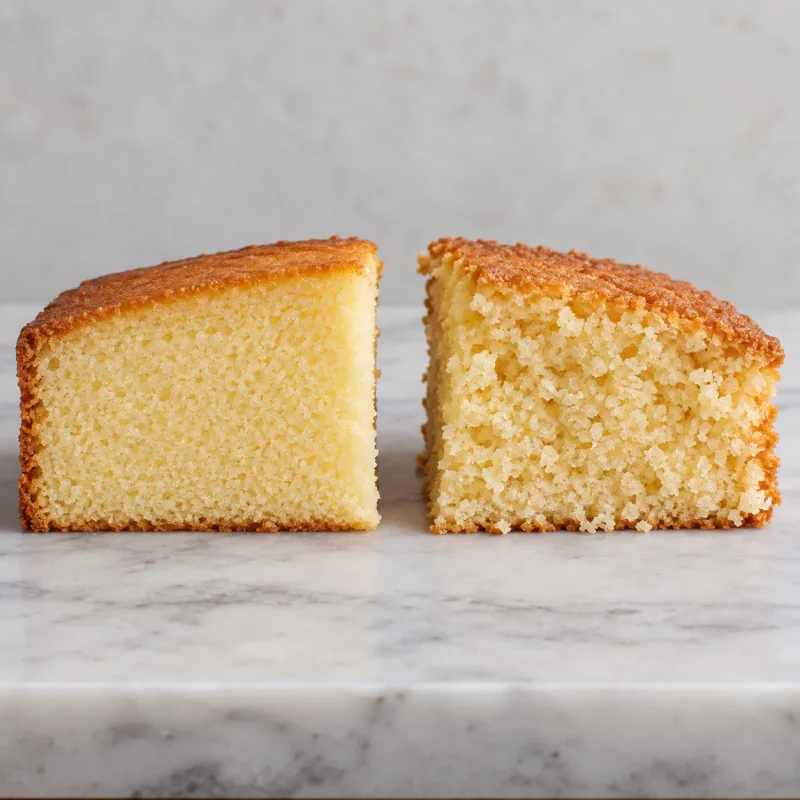
A cake is dry when it is fully baked but has less moisture or tenderness than the recipe intends. The most useful checks are flour quantity, total baking exposure, oven accuracy, pan choice, and major ingredient substitutions.
Do not begin by adding extra milk or oil. If the original balance was lost because of measurement or heat, changing the formula can hide the cause and create a different failure.
Use the cake troubleshooting guide if dryness is only one of several symptoms.
Check flour quantity first
Too much flour shifts the formula toward more starch and protein relative to sugar, fat, eggs, and liquid. The finished crumb can become firmer, rougher, and noticeably drier.
Weigh flour when the recipe provides gram values. Scooping directly with a measuring cup can pack more flour than the recipe developer intended.
If the cake is dry and uniformly heavy, record density as a separate symptom before changing the formula; it may point to an aeration or measurement problem in addition to dryness.
Overbaking keeps removing moisture after the cake has set
A cake can be structurally done before it becomes dry. Continued oven time drives off more water and firms the crumb, especially at the edges.
Begin checking near the early end of the recipe's time range and use the recipe's doneness cues. Do not insist on a completely dry tester when the recipe describes a few moist crumbs as correct.
A cake can therefore be fully baked without being baked to the driest possible endpoint.
Verify the actual oven temperature
If several recipes consistently finish too dark or dry before the expected time, the oven is a meaningful variable.
An oven that runs hotter than its setting accelerates browning and moisture loss. Verify temperature with an appropriate independent thermometer or follow the manufacturer's calibration procedure before permanently changing recipe times.
Repeated dry edges with a raised center can also indicate an edge-to-center heat imbalance rather than a formula problem.
Pan size changes how quickly the cake bakes
A larger pan spreads the batter into a shallower layer, which can bake faster than the original timing suggests. A smaller pan creates a deeper layer that takes longer in the center and can leave the outer crumb overbaked while you wait for the middle.
Recent King Arthur testing on pan substitutions emphasizes that pan capacity and batter depth materially change baking time.
Return to the specified pan while troubleshooting. If you must substitute, use the new geometry as a controlled variable and begin checking doneness earlier or later as appropriate.
Pan material and color can change the exterior
Dark metal absorbs and transfers heat differently from light-colored metal and can brown or set the exterior more aggressively.
This matters most when the recipe was developed around a specific pan style. If the cake becomes dry at the edges after a pan change, restore the original equipment before rewriting the formula.
If the same heat pattern also creates a pronounced raised center, record the dome as a separate heat-balance symptom rather than assuming dryness alone explains it.
Ingredient substitutions can reduce perceived tenderness
Butter and oil do not produce identical eating qualities. Oil remains liquid at room temperature, while butter firms as it cools. Large substitutions involving fat, sugar, dairy, or low-fat alternatives can therefore change tenderness and moisture perception even when the cake still bakes through.
Restore the original tested ingredients when diagnosing a failure. Once the control works, evaluate substitutions deliberately rather than stacking several changes into one bake.
Sugar reductions can change more than sweetness
Sugar affects tenderness, water availability, browning, and the way a cake sets. A substantial reduction can produce a firmer, less moist texture in formulas designed around a higher sugar level.
That does not mean adding sugar is the universal cure for dryness. It means that a dry cake made from a modified recipe should first be compared with the original formula.
What you can do with a dry cake now
A dry cake cannot regain the crumb structure it lost in the oven, but its eating quality can often be improved if it is fully baked. For a layer cake, a light, even application of simple syrup or another recipe-compatible soak can add moisture to exposed cut surfaces; allow it to absorb before filling or frosting rather than saturating the crumb. Serving with cream, custard, fruit, or sauce can also improve the finished dessert, but these are serving corrections, not proof that the original formula was correct.
Dry, dense, and stale are different problems
A dry cake lacks the intended moisture or tenderness. A dense cake is uniformly low in aeration, and a stale cake has changed during storage after baking. The symptoms can overlap, but the fixes are different. If the cake was already dry when first cooled, investigate formula and bake exposure. If it became firm only after storage, packaging and storage conditions deserve separate attention.
Causes, mechanisms, and fixes
| Cause | Mechanism | Matching fix |
|---|---|---|
| Too much flour | Extra dry matter increases water demand and produces a firmer, drier crumb | Weigh flour and restore the tested formula |
| Excess bake exposure | Continued heat drives off more moisture after the structure is already set | Start checking at the correct time and stop at the recipe's physical doneness cues |
| Pan or oven changes | A shallower layer, hotter oven, or more aggressive pan can finish the exterior earlier than expected | Restore the intended pan and verify actual oven conditions |
| Major ingredient substitution | Changes to fat, sugar, dairy, or flour alter tenderness and moisture retention | Re-establish the original formula before designing a substitution |
How to prevent a dry cake on the next bake
- Weigh flour and the other major ingredients.
- Use the specified pan size and material.
- Verify oven temperature if failures repeat.
- Begin doneness checks at the correct point instead of extending the bake for an unnecessarily dry tester.
- Restore original fat, sugar, and dairy ingredients if you substituted them.
- Cool and store the cake as directed before judging final texture.
- Change one variable on the repeat bake.
The target is fully set and tender, not simply "more moist." A correction is successful only if it restores moisture without creating a gummy or underbaked crumb.
Problem solving
Symptoms, causes and corrections
Coarse dry crumb with correct structure
Likely cause: excess flour or excess heat exposure
What to do: Check flour weight, bake endpoint, oven accuracy, and pan.
Edges much drier than center
Likely cause: pan/heat imbalance or prolonged bake
What to do: Restore intended pan size/material and start doneness checks earlier.
Dryness began after ingredient substitution
Likely cause: formula balance changed
What to do: Restore the original fat/sugar/liquid system before compensating elsewhere.