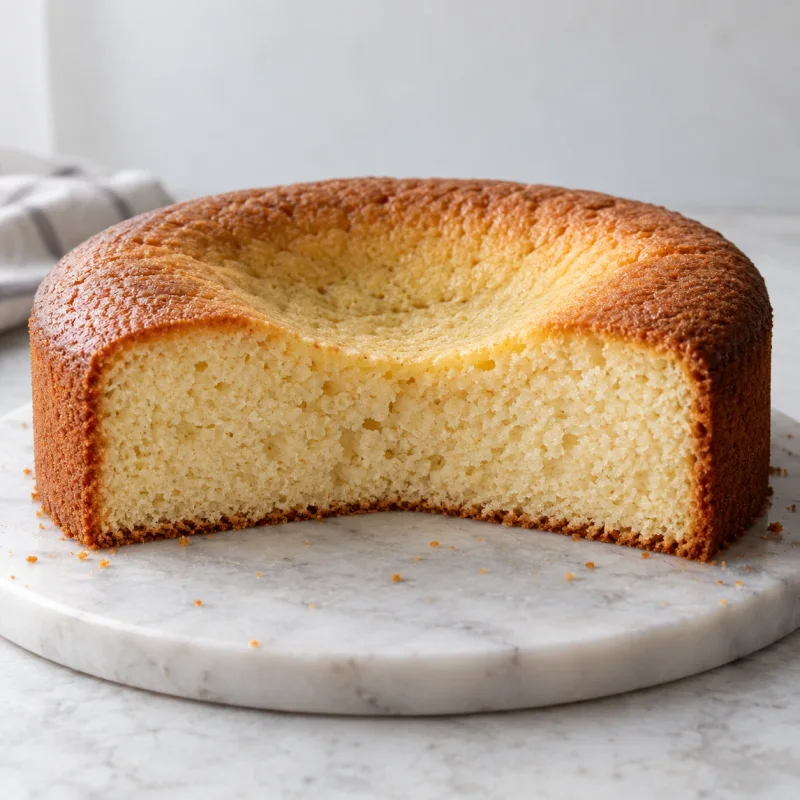
A cake sinks in the middle when the center expands during baking but cannot retain that volume through the end of the bake and cooling. The two highest-value checks are whether the center was fully set and whether the batter expanded more aggressively than its structure could support.
If the cake never rose normally and is heavy everywhere, use the dense cake diagnosis instead. For mixed symptoms, start with the broader cake troubleshooting guide.
What you can do with a sunken cake now
If the cake is fully baked and tastes normal, the lost height cannot be restored, but the cake may still be usable: cool it completely, level it only if needed for assembly, and judge the crumb rather than the profile alone. If the depression contains visibly wet or batter-like crumb, do not serve that unset portion. If incomplete doneness is discovered while the cake is still hot and it can safely remain in its pan, continue baking promptly until the center reaches the recipe's doneness cues; once a cooled cake has structurally collapsed, extra baking will not rebuild the lost volume.
First decide whether the center was underbaked
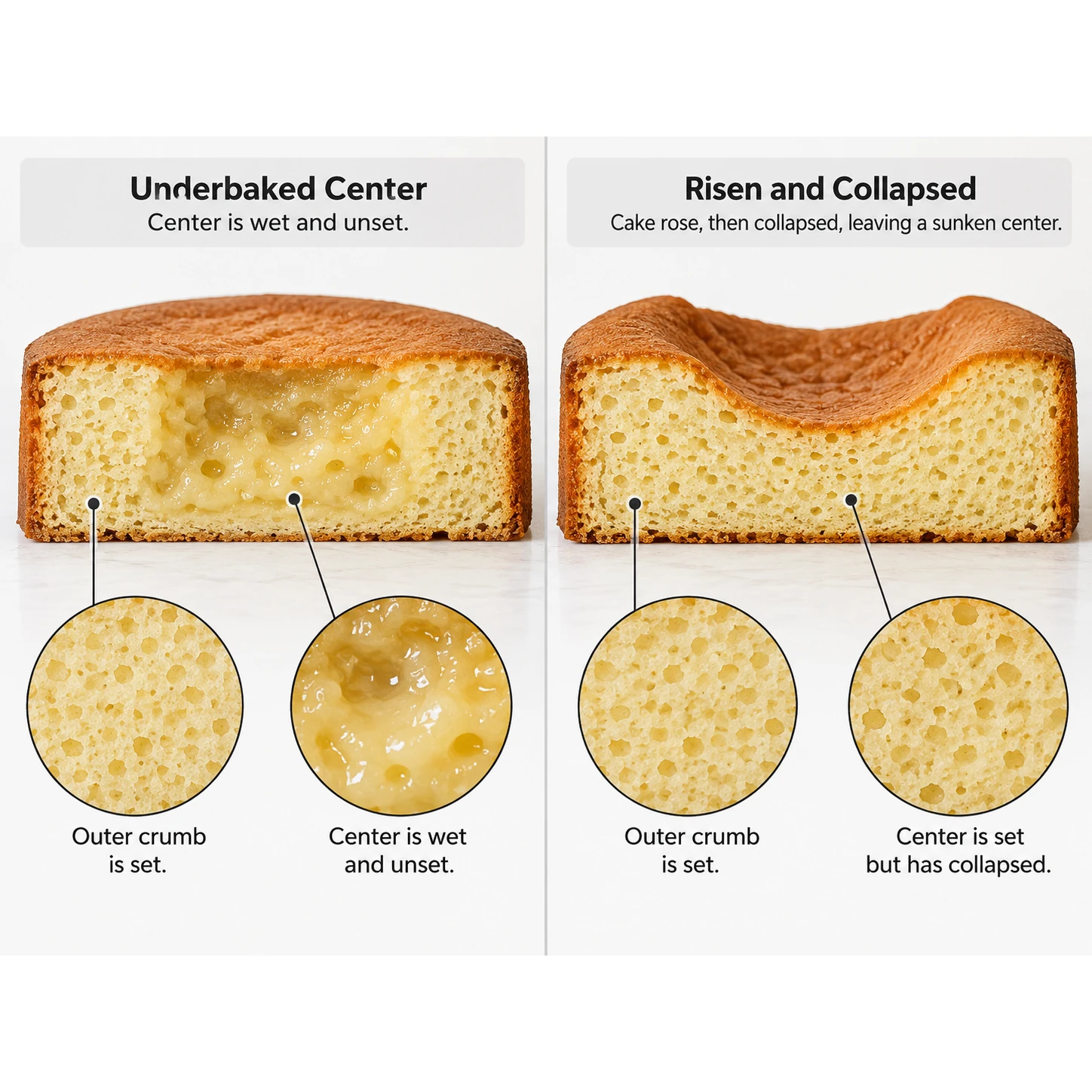
Cut the cooled cake through the deepest part of the depression.
A wet, glossy, pasty, or batter-like center points strongly toward incomplete baking. The edges can look finished because they receive heat earlier than the center. When the cake leaves the oven, a center that has not set sufficiently can no longer support the expanded structure and collapses.
If that is what you see, continue with the specific guide to cake that is raw in the middle. On the next bake, restore the intended pan and batter depth, verify oven temperature, and use several doneness cues rather than the timer alone.
A sunken cake with a fully set center needs a different diagnosis.
A dramatic rise can be a warning sign
Too much leavener can produce rapid expansion followed by collapse. The same general pattern can occur when a creamed batter contains more or less stable aeration than the formula was designed to support.
This does not mean that every sunken cake needs less baking powder. First check whether the leavener was measured correctly, whether a double-acting or single-acting product was substituted unexpectedly, and whether the batter visibly overexpanded before falling.
If the cake rose unusually high and then dropped while the crumb is otherwise baked, expansion-versus-structure balance deserves more attention than simply adding bake time.
Mixing errors can weaken or destabilize the batter
Cake mixing methods create structure in different ways. A creamed butter cake, reverse-creamed cake, sponge, and stir-together oil cake should not be diagnosed by one universal "do not overmix" rule.
Undermixing can leave an uneven batter or insufficient final structure in recipes that require a defined mixing endpoint. Over-creaming butter and sugar can also introduce excessive aeration in some cake systems, producing a high rise followed by compression or gummy streaks.
Follow the recipe's actual mixing sequence and speed. Scrape the bowl when directed. If a recipe specifies a final mixing time, complete it instead of stopping early solely from fear of gluten.
If the main result is a sticky compressed band rather than the visible depression itself, treat the texture as a separate clue rather than assuming the depression explains everything.
Opening the oven is not automatically the cause
The common explanation "you opened the oven door" is too broad. Briefly checking a cake near the correct end of the bake is different from repeatedly opening the oven while the structure is still fragile.
What matters is whether the center had progressed far enough to remain stable. If the oven loses substantial heat early, or the cake is moved or jarred before the center is set, the disturbance can contribute to collapse. Treat this as a timing issue, not a superstition about ever opening the door.
Pan size changes the center-to-edge bake
A smaller pan or a deeper layer gives heat farther to travel before the center sets. The outside can become firm while the middle remains structurally weak.
If you changed pan size, combined batter intended for multiple layers into one deeper pan, or overfilled the pan, return to the recipe's intended geometry before changing the formula.
A deeper cake may also show a raw center, so use the cross-section as evidence.
How to read the crumb after cooling
Use the failure pattern to narrow the cause:
- Wet center + sunken top: incomplete setting is the first problem to solve.
- Fully baked center + unusually high rise before collapse: check leavener measurement and aeration.
- Dense gummy streak under the depression: review mixing and structural collapse; see gummy cake.
- Heavy crumb from edge to center with little normal rise: this belongs more clearly to dense cake.
- Only a shallow settling of a very moist cake: compare with the recipe's intended finish before treating it as a defect.
Causes, mechanisms, and fixes
| Cause | Mechanism | Matching fix |
|---|---|---|
| Center is underbaked | The middle expands but never develops enough set structure to hold its volume after heat is removed | Restore the intended pan and batter depth, verify oven temperature, and bake to physical doneness cues |
| Batter overexpands | Excess leavener or unstable aeration creates more lift than the setting crumb can support | Verify leavener measurement and follow the recipe's aeration method exactly |
| Layer is too deep | Heat reaches the center later than the edges, so the perimeter can look finished while the middle remains weak | Return to the specified pan size and batter quantity |
How to prevent a sunken center on the next bake
- Use the specified pan and batter amount.
- Verify the leavener quantity and freshness without increasing it "for extra lift."
- Follow the recipe's mixing method, speed, and endpoint.
- Verify oven temperature if the problem repeats.
- Begin checking near the stated bake time and use the recipe's physical doneness cues.
- Let the cake cool as directed before making the final crumb diagnosis.
- Change only one uncertain variable when repeating the bake.
The useful distinction is rise versus set: the cake must expand enough to become light, but its center must also develop sufficient structure before that expansion can be retained.
Problem solving
Symptoms, causes and corrections
Center is wet or batter-like after cooling
Likely cause: incomplete setting
What to do: Correct doneness, pan depth, and oven conditions before changing leavener.
Cake rises unusually high, then collapses
Likely cause: overexpansion or unstable aeration
What to do: Verify leavener quantity and the recipe's mixing method.
Center sinks but crumb is set and edges are stable
Likely cause: structural weakness rather than a purely raw center
What to do: Review mixing, aeration, and formula execution.