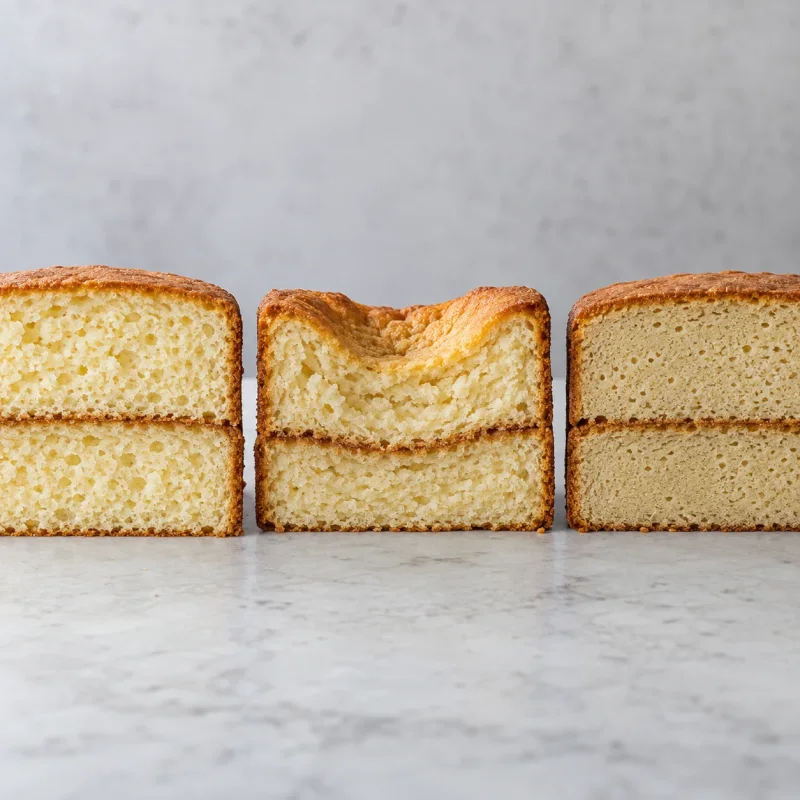
Cake troubleshooting works best when you diagnose the symptom and its timing before changing ingredients. A cake that never rose, a cake that rose and then sank, and a cake that baked through but feels dry can look like related failures while requiring very different corrections.
Use four observations first: what the cake looks like, where the defect appears, when it appeared, and whether the center differs from the edges. Then change one high-probability variable on the next bake so the result is interpretable.
What you can do with the cake you have now
Before planning the next bake, decide whether the current cake is safe, fully baked, and worth serving. A dry or dense but fully baked cake can often be repurposed or served with an appropriate accompaniment. A domed layer can be leveled after it is fully cool, and a cosmetic crack may need no correction at all. A visibly wet, batter-like center should not be tasted or served; route that failure to the raw-center diagnosis instead of treating it as a texture preference.
If the cake has several defects, address the one with the strongest safety or structural consequence first. Rawness outranks shape, and a true collapse outranks a cosmetic surface crack.
Start with the symptom, not the ingredient list
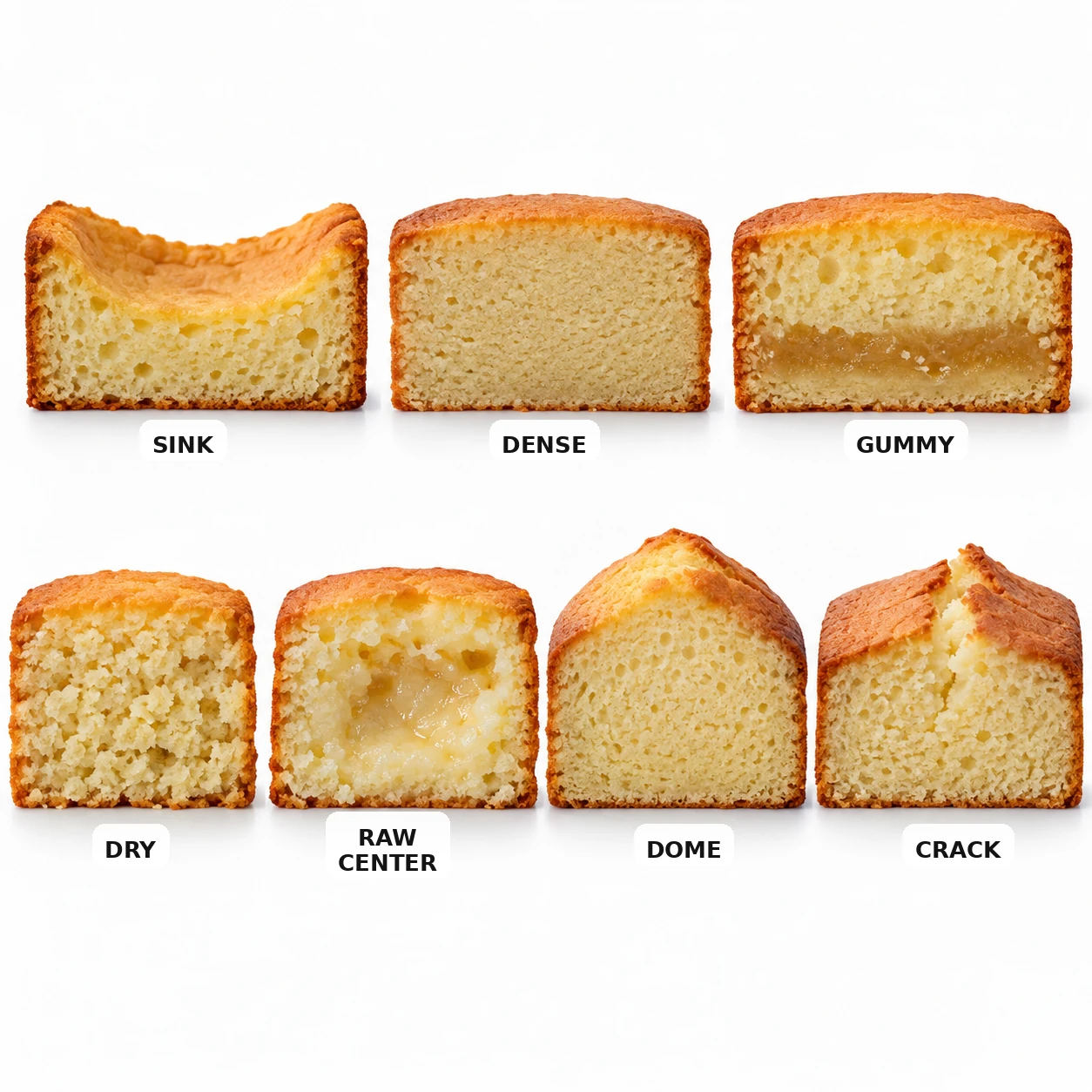
Before blaming flour, eggs, baking powder, or the oven, classify the failure.
| What you see | First diagnostic direction |
|---|---|
| Center rose, then dropped | Structural collapse or incomplete setting |
| Whole crumb is heavy and low-aeration | Aeration, mixing, flour, or leavening |
| Sticky, rubbery, or compressed bands | Doneness, mixing, or post-rise collapse |
| Fully baked but dry or coarse | Flour ratio, overbaking, pan, or substitution |
| Wet or batter-like center | Heat transfer and doneness |
| High center with lower edges | Edge-to-center heating imbalance |
| Split top | Cake-style expectation, surface setting, and expansion |
If more than one symptom is present, decide which one appeared first. A raw center can later produce a sunken center; a dome can crack as the center keeps expanding. The sequence helps separate a primary fault from a secondary symptom.
If the center sank after rising
A cake that rises and then loses height in the middle usually expanded before the center had enough stable structure to retain that volume. Underbaking is common, but excessive leavening or unstable aeration can produce a similar rise-then-collapse pattern.
Use the focused guide for a cake that sinks in the middle when the depression is the defining symptom.
Record whether the cake looked high in the oven, whether the center was wet after cooling, and whether the collapse happened before or after removal. Those details are more useful than simply noting that the cake was "flat."
If the entire cake is dense
A uniformly heavy cake is different from a cake that rose normally and then collapsed. Density points first toward how much usable aeration the batter created and retained, whether the mixing method was completed correctly, and whether the formula was measured accurately.
Go to the dense cake diagnosis when the crumb is fully set but consistently compact from edge to center.
Do not diagnose density until you confirm the cake style. Pound cake, some flourless cakes, and other rich cakes are intentionally tighter than a light layer cake or sponge.
If the crumb is gummy or gluey
A gummy cake may be underbaked, but gumminess can also appear as compressed streaks after the structure rises and collapses. Location matters: a visibly wet center is different from a dense sticky band near the bottom or beneath a sunken area.
Use the gummy cake diagnosis when sticky, rubbery, paste-like, or compressed crumb is the primary defect.
The useful question is not just "Was it baked long enough?" but "Did this area ever set correctly, or did a previously aerated structure compress?"
If the cake is dry but fully baked
Dryness is a moisture-and-tenderness problem, not the same thing as correct doneness. Too much flour, excess baking time, a hotter-than-expected oven, a pan change, or an untested fat or sugar substitution can all shift the finished crumb.
Use the dry cake diagnosis when the cake is structurally set but lacks the tenderness or moisture the recipe intends.
Do not solve dryness by immediately adding extra milk or oil. First restore the tested formula, pan, and bake endpoint; otherwise the correction can create a different structural problem.
If the center is visibly raw
A wet, glossy, batter-like center is primarily a doneness and heat-transfer problem. Pan depth, batter quantity, pan material, oven accuracy, and ending the bake too early are higher-value checks than changing the formula at random.
Use the raw cake center diagnosis when the center is genuinely unset.
A sticky but formed crumb should be routed to gumminess instead. That distinction prevents "bake it longer" from becoming the default answer to every moist-texture problem.
If the cake forms a high dome
A layer cake often domes when the edges set before the center has finished rising. Dark pans, excessive batter depth, and a hotter-than-intended baking environment can increase the edge-to-center difference.
Use the domed cake diagnosis when the center is substantially higher than the edges and the recipe is intended to make relatively flat layers.
The goal is not to suppress all rise. It is to make the edge and center set on a more similar schedule.
If the top cracks
A crack is not automatically a defect. A central split is normal in many loaf and pound cakes, while a deep irregular crack on a layer cake can be evidence that the surface set while the interior was still expanding.
Use the cracked cake top diagnosis when the surface split is the main symptom.
Always compare the result with the intended cake style before changing temperature, pan, or formula.
Causes, mechanisms, and fixes
| Cause pattern | What it does | Best first correction |
|---|---|---|
| Center sets later than the edges | The perimeter becomes firm while the middle is still weak, creating rawness, doming, cracking, or later collapse | Restore the intended pan, batter depth, oven conditions, and doneness endpoint |
| Aeration is too low or unstable | The batter cannot create or retain the air-cell structure the formula expects | Repeat the recipe's exact mixing and aeration method before changing the formula |
| Formula or bake exposure shifts moisture balance | Too much dry matter or excessive heat exposure reduces tenderness and retained moisture | Recheck flour measurement, substitutions, pan geometry, and bake endpoint |
| Expansion exceeds structural support | The cake rises aggressively but the crumb cannot hold that volume through setting and cooling | Verify leavener measurement, mixing, and complete center setting |
These are diagnostic families, not interchangeable fixes. The visible symptom and its timing determine which branch deserves priority.
How to prevent repeat cake failures
- Identify the primary symptom. Describe it precisely: sunken center, wet center, uniform density, gummy band, dry crumb, dome, or crack.
- Note when it appeared. In the oven, immediately after removal, during cooling, or only after cutting.
- Compare center and edge. Large differences often point toward pan geometry or heat-transfer issues.
- Restore the control conditions. Use the intended pan, measured ingredients, mixing method, rack position, and bake cues.
- Verify the oven when failures repeat. A setting is not proof of the actual baking environment.
- Change one variable. One controlled correction produces useful evidence; several changes at once do not.
- Record the result. Pan, batter amount, timing, visual cues, and crumb pattern make the next diagnosis faster.
The purpose of troubleshooting is not to collect every possible cause. It is to move from an observable symptom to the smallest defensible next test.
Problem solving
Symptoms, causes and corrections
Center rose, then dropped
Likely cause: incomplete setting or unstable overexpansion
What to do: Check the cooled center, rise timing, pan depth, and leavening before changing the formula.
Whole crumb is uniformly heavy
Likely cause: aeration, mixing, flour measurement, or leavening
What to do: Compare the actual mixing method and measured flour with the recipe; route to dense-cake diagnosis.
Sticky or compressed band
Likely cause: underbaking, mixing fault, or post-rise compression
What to do: Identify where the gummy zone sits and whether the center is visibly raw.
High center and lower edges
Likely cause: edge-to-center heat imbalance
What to do: Check pan color, batter depth, oven heat, and whether the cake style should bake flat.