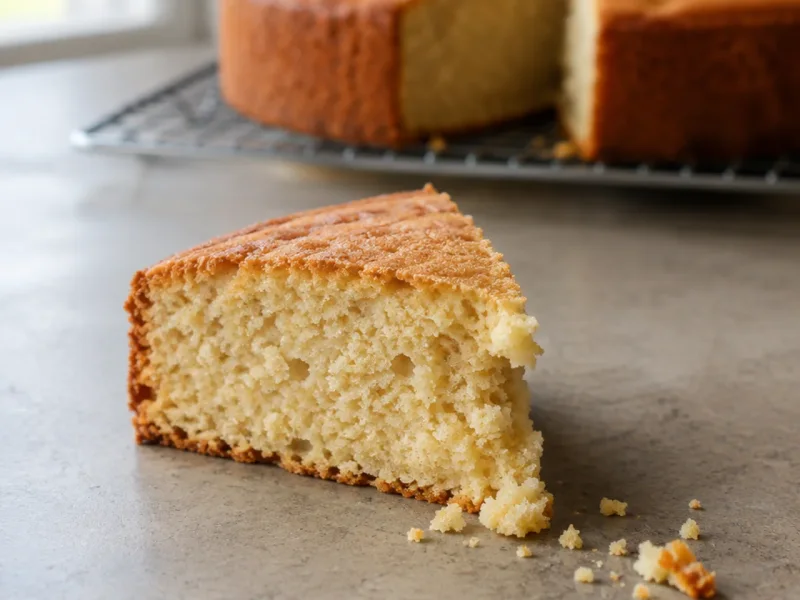
A cake is crumbly when the baked crumb does not hold together as well as the recipe intends. The most useful first step is to separate dry, sandy crumbling from moist but fragile crumbling and from a cake that simply breaks while being removed from the pan. Those patterns can look similar on the plate but point to different corrections.
If the cake is noticeably dry as well as crumbly, start with flour measurement and baking time. If it is moist but falls apart easily, check whether the formula or mixing method provided enough structure. If the crumb looks normal until the layer is turned out, sliced, or moved, the problem may be handling or pan release rather than the cake formula.
For a broader diagnosis, use the cake troubleshooting guide.
First identify what kind of crumbling you have
Do not treat every crumbly cake as a moisture problem. Use the cooled cake to identify the dominant pattern.
| What you see | Most useful direction to check first | Why it matters |
|---|---|---|
| Dry, sandy crumb that breaks into small particles | Flour measurement, bake time, oven heat | Too much flour or excess moisture loss can make the crumb both dry and fragile |
| Moist crumb that breaks into soft chunks | Formula balance, egg or binder changes, recipe-specific mixing | The cake may contain moisture but lack enough structure to hold a clean slice |
| Cake tears mainly at the bottom or sides during unmolding | Pan preparation, release timing, handling | A sound crumb can still break if it sticks to the pan or is moved before it can support itself |
| Crumb is tough, rubbery, or unusually compact as well as fragile | Mixing and aeration | This is no longer a simple crumbly-cake pattern; route the diagnosis toward texture and density |
This distinction prevents a common mistake: adding more liquid or fat to a cake that was already moist but structurally weak.
Too much flour can make cake dry and crumbly
Excess flour changes the ratio of dry material to eggs, fat, sugar, and liquid. The batter becomes less balanced, and the baked cake can feel firm, dry, or crumbly rather than tender and cohesive.
This is especially easy to do when flour is measured by volume. Scooping directly with a measuring cup can compact flour and add substantially more than the recipe intended.
For the next bake:
- use gram weights when the recipe provides them;
- if measuring by cups, use the method specified by the recipe rather than packing flour into the cup;
- verify that you used the correct flour type as well as the correct quantity;
- do not compensate for suspected excess flour by randomly adding milk or oil after the fact.
If the cake is clearly dry throughout, continue with the more specific dry cake diagnosis.
Overbaking can turn a tender crumb into a fragile one
A cake that stays in the oven too long continues losing moisture after its structure has already set. The result can be a crumb that feels dry and breaks apart easily when cut.
Do not diagnose overbaking from color alone. Dark pans, cocoa, sugar level, and recipe style can all change browning. Compare the actual bake with the recipe's expected time range and doneness cues, and consider whether your oven runs hotter than its setting.
For the repeat bake, change one variable at a time. If the formula was measured correctly, check doneness earlier rather than immediately lowering the temperature, changing the pan, and adding more liquid at once.
A moist cake can still be crumbly when structure is weak
Moisture and structure are not the same thing. A cake can feel moist on the tongue yet break into soft chunks because the network that holds the crumb together is too weak for that formula.
Eggs are one possible structural component in cakes that use them. They contribute protein, emulsification, binding, moisture, and, in some styles, aeration. Reducing the number of eggs, using a different egg size, or making an untested substitution can therefore change more than moisture alone.
The correct response is not to add an arbitrary extra egg. Restore the tested recipe first. If the recipe intentionally uses an egg substitute, follow the substitution designed for that specific cake style rather than assuming every replacement performs the same structural role.
The flour system also contributes structure. In wheat-based cakes, gluten development needs to be appropriate for the mixing method: too little development can leave some formulas weak, while excessive development can move the texture toward tough, rubbery, or dense. Follow the recipe's mixing endpoint rather than applying a universal rule such as “mix as little as possible.”
Undermixing can cause crumbling in some cake methods
Undermixing is often overlooked because bakers are commonly warned only about overmixing. In a cake whose method depends on developing a homogeneous batter and enough supporting structure, stopping too early can leave the cake fragile or uneven.
This does not mean every crumbly cake needs more mixing. Sponge cakes, creamed cakes, reverse-creamed cakes, and one-bowl oil cakes build structure and aeration differently. The useful question is whether the recipe's specified mixing stage was actually reached.
On the next bake:
- follow the stated order of ingredients;
- scrape the bowl so no pockets of flour or fat remain;
- complete the creaming, whipping, folding, or final mixing stage the recipe calls for;
- stop at that endpoint rather than adding extra mixing “for safety.”
If the finished crumb is uniformly heavy or compact rather than simply fragile, use the dense cake diagnosis.
Check whether the cake is crumbling because it stuck to the pan
A cake that looks intact in the pan but tears when turned out may not have a crumb-formula problem at all.
Look for these clues:
- the bottom crust remains attached to the pan;
- one side tears while the interior crumb looks normal;
- the layer breaks at the moment it is inverted or lifted;
- the cake is very tender and was handled before it had enough time to firm up.
Use the pan preparation specified by the recipe. Depending on the cake, that may mean greasing, flouring, parchment on the base, or a particular release method. Also follow recipe-specific cooling instructions. Some layers should be turned out after a short cooling period; others are intentionally delicate and are safer when left in the pan longer.
Do not apply one universal unmolding time to every cake.
What not to do with a crumbly cake
A visible symptom is not a complete diagnosis. Avoid making several corrective changes at once.
Do not automatically add more milk or oil
Extra liquid can make a dry batter looser, but it can also disturb a formula that was already properly hydrated. A moist-but-fragile cake does not necessarily need more moisture.
Do not automatically add another egg
If an egg was accidentally omitted, restoring the recipe is sensible. Adding an extra egg to an already correct formula changes structure, emulsification, liquid, and fat at the same time.
Do not blame overmixing by default
Excess mixing after flour addition can cause toughness or other texture faults, but “overmixed” is not a reliable universal explanation for a cake that simply crumbles. Match the mixing diagnosis to the cake method and the rest of the crumb symptoms.
Causes, mechanisms, and matching fixes
| Likely cause | What it changes | Best next-bake correction |
|---|---|---|
| Too much flour | Raises the dry-material proportion and can make the crumb dry and fragile | Weigh flour and restore the tested formula |
| Excess baking time or heat | Removes more moisture than intended | Verify oven behavior and begin checking doneness at the recipe's earlier cue |
| Egg quantity, size, or substitution changed | Can reduce binding, emulsification, aeration, or protein structure depending on the formula | Return to the tested egg specification or a recipe-tested substitute |
| Batter stopped before the method's required mixing endpoint | Can leave some cake systems insufficiently homogeneous or supported | Complete the recipe-specific mixing stage |
| Cake stuck during release | Mechanically tears an otherwise acceptable crumb | Use the specified pan preparation and release method |
| Very tender layer handled too early | The warm cake may not yet support moving or stacking | Follow the recipe's cooling and unmolding instructions before handling |
How to rescue a cake that is already crumbly
The best rescue depends on whether the cake is dry, structurally fragile, or merely broken during handling.
If the cake is dry but still sliceable, a compatible syrup, glaze, filling, or frosting can add serving moisture. This improves eating quality but does not rebuild the baked structure.
If the cake is moist but fragile, chill completely before decorating, move layers with broad support, and apply filling gently. Buttercream or ganache can help hold a cracked layer together, but heavy fillings may make a weak layer harder to handle.
If the cake has broken into many pieces, use a format that does not depend on intact layers. Trifle and cake pops are practical options. Repurposing is usually more reliable than trying to force a severely fragmented cake back into a clean layer.
If the center is sticky or paste-like, use the gummy cake diagnosis. If the center is visibly underbaked, use the raw-center diagnosis instead of treating crumbling as the primary fault.
How to prevent a crumbly cake on the next bake
- Confirm the cake is actually meant to have a cohesive slice; some very tender styles are naturally more delicate.
- Repeat the tested ingredient quantities before changing the formula.
- Weigh flour when possible and use the specified flour type.
- Use the egg quantity and size the recipe calls for, or a substitution tested for that formula.
- Complete the recipe-specific mixing method rather than relying on a universal mixing rule.
- Check the cake at the correct doneness window instead of extending the bake unnecessarily.
- Prepare the pan and release the cake according to the recipe.
- Let delicate layers cool enough to support handling.
- Change only one high-probability variable on the repeat bake and record the result.
The key diagnostic rule is simple: crumbly does not automatically mean dry. Decide whether the cake lost too much moisture, lacks enough structure, or was mechanically damaged. Once those three paths are separated, the next correction becomes much more precise.
Problem solving
Symptoms, causes and corrections
Dry, sandy crumb
Likely cause: excess flour or excess moisture loss
What to do: Verify flour weight, bake time, and oven behavior before changing the formula.
Moist crumb breaks into soft chunks
Likely cause: insufficient structure or formula/mixing change
What to do: Restore the tested egg/binder specification and recipe-specific mixing method.
Interior looks normal but layer tears during unmolding
Likely cause: mechanical sticking or handling damage
What to do: Check pan preparation and recipe-specific cooling/release instructions.