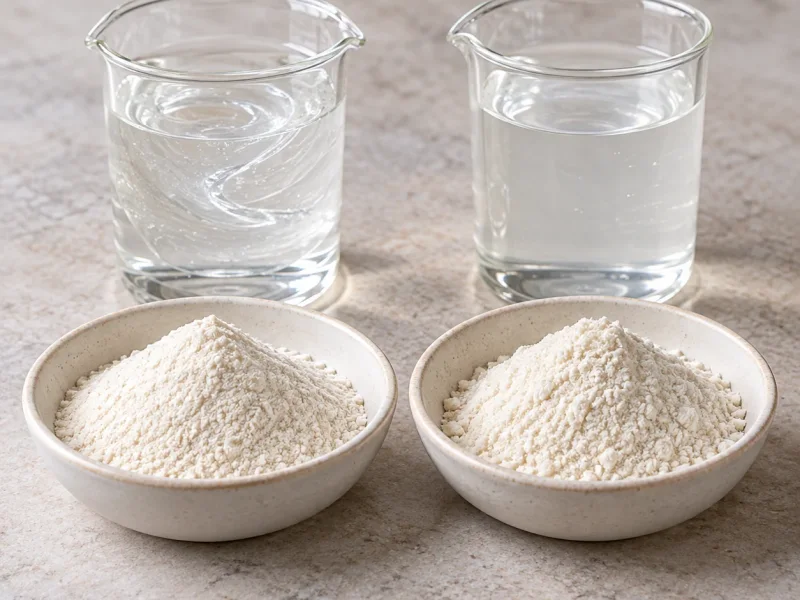
Guar gum and xanthan gum are both food thickeners, but they are not interchangeable by default. Guar gum (E 412) is a galactomannan extracted from guar seeds; xanthan gum (E 415) is a polysaccharide produced by microbial fermentation. Both can build viscosity in water-based formulations, and both can become easier to move as stirring or pumping increases. Their hydration, flow profile and performance in the finished product differ. Select by the texture and stability the food needs—not by a fixed gram-for-gram conversion.
Guar gum vs xanthan gum at a glance
| What matters | Guar gum (E 412) | Xanthan gum (E 415) |
|---|---|---|
| Production | Extracted from guar seed endosperm | Produced by controlled fermentation, then purified |
| Role in foods | Builds body and water-phase viscosity | Provides viscosity with often pronounced shear-thinning flow |
| Behavior under stirring | Can be shear-thinning; response varies with grade and concentration | Frequently shows marked shear-thinning; easy movement under applied shear |
| In a pourable suspension | Can help reduce particle movement by increasing viscosity | Often worth testing where pourability and resistance to settling are both required |
| Dispersion and hydration | Can hydrate in cold water; inadequate dispersion causes lumps or uneven viscosity | Also hydrates in water; mixing sequence and sufficient hydration remain important |
| A self-supporting gel on its own? | Not the usual function | Not the usual function |
| Direct 1:1 replacement | Not a validated general rule | Not a validated general rule |
For the identity and production of each ingredient, consult the guar gum profile and xanthan gum profile. This article examines which performance differences matter when making a formulation decision.
How do their textures differ?
Guar gum contributes body as its galactomannan chains hydrate. Viscosity may continue to develop after initial mixing. A sample tested too early can therefore appear thinner than it will be after the intended hydration period. Guar solutions may also show shear-thinning behavior; describing guar as always Newtonian and xanthan as the only shear-thinning gum would be incorrect.
Xanthan gum is often selected for a strong change in apparent viscosity with shear rate. A formulation may resist slow flow or settling when undisturbed yet become easier to pour or pump when force is applied. That feature makes xanthan a candidate for dressings and suspensions. It does not prove that every xanthan-containing product is stable: particle size, continuous-phase composition and storage conditions still matter.
Comparisons need the same reference conditions. Viscosity recorded at one concentration, temperature, shear rate or hydration time cannot be treated as a universal property of the gum. Product-grade specifications also vary.
Which should you choose for a particular food?
| Finished-product requirement | Useful starting candidate | Verification in the actual product |
|---|---|---|
| More body without changing the overall product concept | Guar gum | Final viscosity after hydration, mouthfeel and processing tolerance |
| A dressing that pours but resists separation of visible particles | Xanthan gum | Pouring effort, settling during storage and response to acidity and salts |
| A beverage containing dispersed solids | Compare xanthan with guar under matched conditions | Sediment, appearance, drinking texture and storage behavior |
| A frozen dessert mix | Test guar, xanthan or an evaluated stabilizer system | Mix viscosity, freeze–thaw changes, melting behavior and mouthfeel |
| A recipe that already includes another hydrocolloid | Test the complete stabilizer combination | Interactions between polymers and changes in the finished texture |
These are screening choices, not fixed prescriptions. Increasing water-phase thickness may slow droplet or particle motion, but it will not necessarily repair an unstable emulsion, inadequate mixing or unsuitable emulsifier system.
Example: a dressing with suspended herbs
If herbs fall to the bottom while the dressing also needs to pour cleanly, measuring only thickness after vigorous stirring misses part of the problem. Compare the control and candidate gums after matched hydration. Check flow during pouring, then leave samples undisturbed and evaluate herb distribution over the intended storage period. Xanthan may be a useful candidate; a satisfactory result still depends on the full formulation.
Example: a smooth frozen dessert
For a frozen dessert, the thickest liquid mix is not automatically the best one. Compare mix viscosity with the finished frozen texture, melting behavior and changes during storage. Fat, sugars, milk or plant proteins and other stabilizers affect the outcome. This is a distinct application problem—not evidence that one gum is always superior in ice cream.
Can xanthan gum replace guar gum, or vice versa?
Not with a reliable universal 1:1 ratio. Equal weights do not guarantee equal mouthfeel, apparent viscosity, suspension or processing performance. A commercial grade's hydration speed and the ingredients already present may matter more than a ratio taken from a different food system.
A defensible substitution uses a controlled comparison:
- Define the target. Record what must remain acceptable: pourability, coating, resistance to settling, smoothness, water separation or frozen texture.
- Keep the base formulation unchanged. Record water content, fat and solids, pH, mixing order and processing conditions; vary the gum deliberately rather than several ingredients at once.
- Check grade and dispersion instructions. Uneven wetting can create lumps. Follow the supplier's food-grade preparation guidance for each gum.
- Allow comparable hydration. Assess viscosity and texture after the intended preparation period, not when one sample is still hydrating.
- Measure under relevant conditions. A single viscosity number does not describe both resting structure and flow during use. Record temperature and shear conditions wherever possible.
- Reassess after processing and storage. Reject a replacement that looks acceptable immediately but fails the product's actual stability or texture criteria later.
No single concentration, pH threshold or replacement percentage is appropriate for all products. Confirm use conditions against the applicable food-additive rules for the product category and jurisdiction.
Do guar and xanthan become stronger when combined?
Some mixtures show synergistic rheological behavior, including a higher viscosity than predicted from separate components. Controlled studies have shown that this behavior changes with xanthan structure, salt concentration, temperature and mixing conditions. It is not a guarantee for every commercial grade or recipe, and it does not establish a universal optimal mixing ratio.
One study of dilute xanthan–guar solutions reported markedly different interaction behavior for native and deacetylated xanthan. The authors did not observe a self-supporting gel in the mixtures studied. Thus greater viscosity is not equivalent to gel formation. Results in simple test solutions cannot be transferred unchanged to acidic dressings, beverages, protein-rich products or ice cream. Khouryieh et al., Journal of Food Science (2007).
What commonly distorts a comparison?
- Incomplete hydration: the gum that disperses faster may appear more effective before the slower sample finishes hydrating.
- Different grades: particle size, processing and supplier specifications affect the comparison.
- Only one shear rate: thickness at rest and ease of pouring are not the same measurement.
- Different composition: sugar, salt, acid, protein or fat can alter the result.
- Short observation: freshly prepared texture does not establish shelf-life stability.
- Uncontrolled combinations: another stabilizer may interact with both gums and change the interpretation.
An auditable test should record the gum identity, preparation method, formula, observation times and acceptance criteria. Without this information, claims that one gum is categorically “stronger” are difficult to evaluate.
Guar gum E 412 and xanthan gum E 415 on ingredient lists
In European food-additive terminology E 412 refers to guar gum and E 415 to xanthan gum. The additive numbers identify different materials; they do not define substitution ratios. Regulation (EU) 2026/196 updates certain use conditions and specifications. Permissions and maximum levels depend on the category of food and current legal provisions, so the E-number alone is not sufficient to determine whether a proposed formulation is permitted.
Frequently asked questions
Which is the better thickener?
Neither is uniformly better. Choose the gum whose performance matches the food's required viscosity, flow, texture and stability after normal processing and storage.
Are both gums shear-thinning?
They can be. Xanthan frequently exhibits a pronounced response, while guar's response depends on concentration, grade and conditions. Measurements must be compared at specified shear rates.
Can I mix guar gum and xanthan gum?
Yes, but a mixture may behave differently from either ingredient alone. Test the blend in the finished food instead of assuming that every ratio gives synergy or a gel.
Must I heat either gum to thicken water?
Useful viscosity can develop in water without starch-style cooking. Proper dispersion and sufficient hydration are still required, and commercial grades differ.
Why did a replacement work in water but fail in a sauce?
A sauce contains other interacting components such as acids, salts, fat, proteins and emulsifiers. These can change hydration, apparent viscosity and storage behavior compared with plain water.
Research references
- Mudgil, Barak & Khatkar (2014): Guar gum processing, properties and food applications — structure, hydration and food functions of guar.
- Khouryieh et al. (2007): Rheological properties of xanthan–guar interactions — conditional rheological interaction and limits of gel claims.
- Khouryieh et al. (2007): Effects of salt concentration on xanthan–guar solutions — ionic effects and conditions of the experimental model.
- European Commission: Regulation (EU) 2026/196 — updated legal text concerning E 412 and E 415 in specified uses.