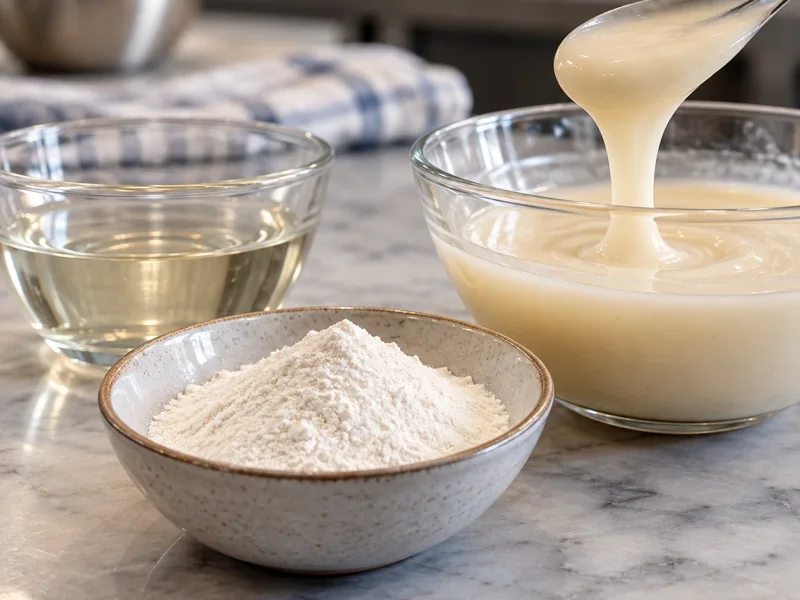
On a food label, the words xanthan gum tell you which additive is present, but not why the manufacturer chose it. The same ingredient can thicken a sauce, help particles stay suspended in a drink, stabilize a dressing, or improve cohesion in a gluten-free batter. Those uses come from how xanthan changes the flow and physical stability of the water phase.
It is not a sweetener, preservative, or source of gluten. Its value in food is mainly technological rather than nutritional.
Xanthan gum at a glance
| Question | Short answer |
|---|---|
| What is it? | A fermentation-produced polysaccharide used as a food additive |
| What does it do? | Thickens, stabilizes, suspends particles, and controls flow |
| EU identifier | E 415 |
| Codex identifier | INS 415 |
| US regulatory reference | 21 CFR 172.695 |
| Common food contexts | Sauces, dressings, fillings, frozen foods, beverages, and some gluten-free products |
How xanthan gum is made
Food-grade xanthan gum is produced by fermenting a carbohydrate-containing medium with bacteria from the Xanthomonas group. US regulation specifically defines xanthan gum as a polysaccharide derived from Xanthomonas campestris by pure-culture fermentation. After fermentation, the gum is recovered and purified; the finished additive must not contain viable production cells.
The important distinction is between the fermentation feedstock and the final ingredient. A manufacturer may use different carbohydrate sources in the fermentation medium, but the ingredient listed on the finished food is xanthan gum. The words “xanthan gum” on a label therefore do not, by themselves, tell you which carbohydrate source was used during production.
What xanthan gum does in food
Xanthan gum changes the behavior of the water phase in a food. That can solve several different formulation problems, which is why the same ingredient appears in products that otherwise have little in common.
It thickens without needing to form a firm gel
Xanthan gum can raise viscosity — in plain language, it can make a liquid feel thicker or more resistant to flow. That is useful in products such as sauces, dressings, gravies, fillings, and some beverages.
Unlike gelatin, xanthan gum is not mainly used to create a firm, sliceable gel. Its more typical role is to give a liquid or semi-liquid product body while keeping it pourable or spoonable.
It helps keep particles and droplets distributed
When a liquid becomes more viscous, suspended particles and dispersed droplets move more slowly. That can help reduce settling and separation during storage.
This is why xanthan gum is often described as a stabilizer as well as a thickener. In a dressing, for example, the useful effect may be less about making the product “thick” and more about helping spices, droplets, and other dispersed material remain more evenly distributed.
It is strongly shear-thinning
Xanthan solutions are strongly shear-thinning: they can be relatively viscous while standing still but flow more easily when stirred, pumped, squeezed, poured, or swallowed. When the force decreases, the apparent viscosity rises again.
That behavior is especially useful in products that need to resist separation in the package but still pour easily during use.
Where xanthan gum is commonly used
Xanthan gum is not tied to one food category. Its function depends on the surrounding formulation.
| Food type | Why a formulator may use xanthan gum |
|---|---|
| Salad dressings and sauces | Adds body and helps limit separation |
| Gravies and savory preparations | Controls viscosity and texture |
| Bakery fillings and dessert systems | Helps manage flow and physical stability |
| Frozen desserts | Supports texture and water management |
| Beverage systems | Helps suspend particles and control consistency |
| Gluten-free doughs and batters | Adds viscosity and cohesion where a wheat-gluten network is absent |
This does not mean every product in those categories contains xanthan gum. Manufacturers choose hydrocolloids according to the product, process, desired texture, other ingredients, labeling goals, and cost.
Why xanthan gum is used in gluten-free foods
Gluten gives wheat dough a viscoelastic network that helps it retain gas and maintain structure. Gluten-free flour systems do not form that same network, so formulators may use hydrocolloids such as xanthan gum to change viscosity, cohesion, and gas retention.
Xanthan gum does not become gluten and does not reproduce every property of gluten. It changes the behavior of the water phase and can help a gluten-free batter or dough hold together more effectively. The useful amount depends on the product and the rest of the formula, so there is no single universal dose that works for every gluten-free food.
Is xanthan gum an emulsifier or a stabilizer?
The most useful consumer answer is: it is commonly used as a thickener and stabilizer, while some regulatory and technical systems also place it in emulsifier-related functional classes.
That does not mean xanthan gum behaves exactly like a classic small-molecule emulsifier. In many foods, its practical contribution comes from increasing viscosity and slowing the movement of droplets or particles, which helps the system remain physically stable.
So when xanthan gum appears in a product, the better question is not “Which single label describes it?” but “What physical problem is it solving in this formulation?”
What E 415 means on a food label
E 415 is the European identifier for xanthan gum. It identifies the additive; it is not a hazard score, purity grade, or statement of how much is in the food.
In the European Union, additives are identified on ingredient lists by their functional class together with their specific name or E-number. A label may therefore identify xanthan gum in a format such as a stabilizer or thickener followed by “xanthan gum” or “E 415.”
Codex Alimentarius uses INS 415 in its International Numbering System. The INS number identifies xanthan gum within the Codex system, but individual countries still apply their own legal rules and conditions of use.
In the United States, ingredients are generally declared by their common or usual name, so consumers will typically see xanthan gum rather than E 415.
How xanthan gum is regulated in the United States and European Union
The United States and European Union do not use identical legal systems, so the institutions and terminology should not be collapsed into one generic statement such as “FDA and EFSA approve xanthan gum.”
In the United States, FDA regulates xanthan gum as a direct food additive. The federal regulation at 21 CFR 172.695 defines the additive, sets manufacturing and specification requirements, and allows its use under prescribed conditions for technological purposes including stabilization, thickening, suspension, bodying, emulsification, and foam enhancement where applicable standards do not preclude the use.
In the European Union, xanthan gum is authorized as E 415 under EU food-additive legislation. EFSA performs scientific risk assessment; the European Commission and EU legislation govern authorization, conditions of use, and specifications. Commission Regulation (EU) 2026/196 updated requirements for E 415 after EFSA's re-evaluation and follow-up work.
That distinction matters because a scientific risk assessor and a legal regulator do different jobs.
Is xanthan gum safe to eat?
For its authorized uses as a food additive, current US and EU regulatory frameworks permit xanthan gum under defined conditions. EFSA's 2017 re-evaluation concluded that a numerical acceptable daily intake was not needed and found no safety concern for the general population at the reported uses and use levels. A 2023 EFSA follow-up also addressed specific uses in foods for infants below 16 weeks of age and informed later EU specification changes.
There is also newer evidence that deserves proportionate context. A 2026 study in rats reported changes in colon microbiota, barrier-related markers, inflammatory cytokines, and mild colon inflammation after chronic dietary xanthan-gum exposure. That study is relevant because it adds new biological evidence, but it is an animal study. It does not by itself establish equivalent harm from typical human food exposure, and it does not overturn the current regulatory status of xanthan gum.
The practical interpretation is therefore neither “xanthan gum is harmless in unlimited amounts” nor “a new study proves xanthan gum is dangerous.” The stronger conclusion is that its authorized food uses remain permitted, while newer findings should continue to be weighed as human evidence develops.
Xanthan gum compared with other thickeners
Different thickeners solve different formulation problems, so they are not automatically interchangeable.
For a plant-derived galactomannan with different hydration and flow behavior, see guar gum.
For a fermentation-derived hydrocolloid that can form ion-sensitive gel and suspension networks rather than relying mainly on viscosity, compare it with gellan gum.
| Ingredient | Main practical difference from xanthan gum |
|---|---|
| Guar gum | Another polysaccharide thickener, but with different hydration and flow behavior |
| Starch | Thickens through a different mechanism and is often more dependent on heat and starch type |
| Gelatin | A protein that can form thermoreversible gels; xanthan is a polysaccharide and behaves differently |
| Cellulose gums | Modified cellulose ingredients with their own hydration and texture profiles |
A substitution that works in one sauce or dough may fail in another because the surrounding formulation — water, salt, sugar, fat, temperature, processing, and other hydrocolloids — changes the result.
What the ingredient name does not tell you
Seeing “xanthan gum,” “E 415,” or “INS 415” tells you the identity of the additive, but not the whole formulation story. The label does not normally tell you:
- which carbohydrate source was used during fermentation;
- the exact amount present in the finished food;
- which technical function matters most in that specific product;
- whether xanthan gum is being used together with another hydrocolloid;
- the manufacturer's processing grade or particle-size specification.
That is a useful limit to remember when reading ingredient lists: the label identifies the ingredient, not the complete manufacturing formula.
Sources
- 21 CFR 172.695 — Xanthan gum — US legal definition and conditions of use.
- EFSA Journal — Re-evaluation of xanthan gum (E 415), 2023 follow-up — EU scientific risk-assessment follow-up, including infant-use assessment.
- Commission Regulation (EU) 2026/196 — current EU amendments to E 415 uses/specifications following EFSA work.
- PLOS One, 2026 — chronic xanthan-gum exposure in rats — recent animal evidence relevant to safety context.