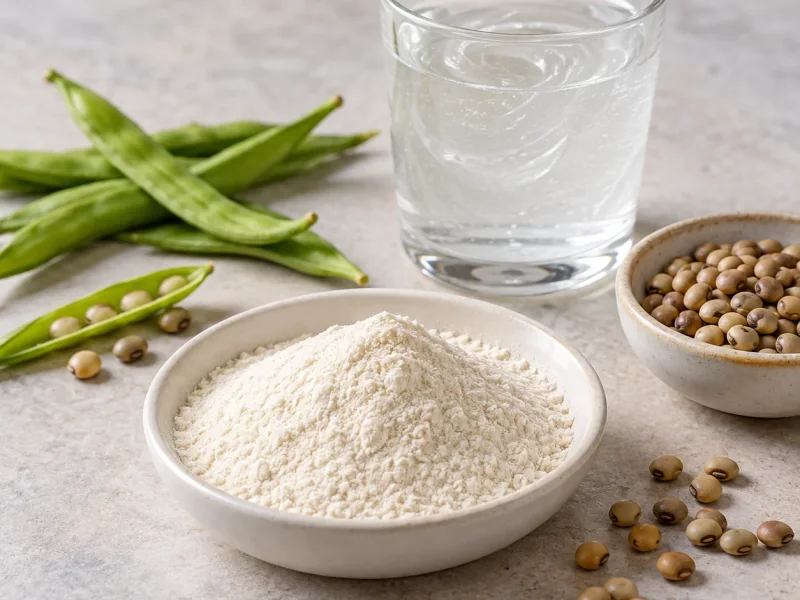
Guar gum is a plant-derived food hydrocolloid used primarily to thicken and stabilize water-containing foods. It is obtained from the seed endosperm of the guar plant and consists largely of galactomannan, a carbohydrate polymer that hydrates in water and increases viscosity. Manufacturers use it to adjust texture, limit visible separation and manage water in sauces, dressings, dairy-style products and frozen desserts. On European labels, its additive identifier is E 412.
Its value is technological: the important question is not simply whether guar gum is present, but what it contributes to a particular product and how it behaves alongside the other ingredients.
Guar gum at a glance
| Question | Practical answer |
|---|---|
| What is it? | A seed-derived galactomannan hydrocolloid |
| Botanical source | Guar, Cyamopsis tetragonoloba |
| Main functions | Thickening, water binding and physical stabilization |
| EU additive identifier | E 412 |
| Codex identifier | INS 412 |
| Main hydration characteristic | Develops viscosity in water without requiring starch-style cooking |
| Typical food contexts | Sauces, dressings, soups, frozen desserts and some dairy or plant-based formulations |
Where guar gum comes from
Guar is a leguminous crop. The useful gum is concentrated in the endosperm, the carbohydrate-rich part of its seeds. In commercial processing, seeds are cleaned, split and separated to isolate the endosperm; the resulting material is milled and refined into a pale powder. Food-grade specifications, particle size and processing choices affect how the powder disperses and hydrates.
Guar gum is not the same substance as xanthan gum. Guar is recovered from plant seeds, whereas xanthan gum is produced through microbial fermentation. Although both can thicken a liquid, this difference in chemistry and molecular structure affects their flow behavior and performance in a formulation.
How guar gum works in food
Guar gum is a galactomannan: a long chain of mannose units with galactose side branches. These polymers interact strongly with water. When properly dispersed and hydrated, the chains expand and become entangled, increasing the liquid's resistance to flow. The food can become thicker even though the gum contributes relatively little mass.
It increases viscosity
The most visible effect is thickening. An aqueous sauce that would otherwise be thin can gain body and a more substantial mouthfeel. The level of thickening depends on the gum grade and concentration, available water, mixing conditions, hydration time and composition of the liquid.
Increasing the quantity does not always produce a desirable result. More viscosity can make a dressing harder to pour or a drink unpleasantly heavy. The objective is an appropriate flow profile, not simply the thickest possible product.
It helps control separation
Guar gum can slow the movement of suspended particles and dispersed droplets by thickening the surrounding water phase. That can help a dressing retain a more even appearance and can reduce visible settling in suitable formulations. It does not remove the need for an effective emulsion process or a suitable emulsifier when an oil-in-water emulsion must be formed and maintained.
It manages water and texture
Water binding and viscosity are relevant to chilled and frozen products. In frozen desserts, stabilizers influence the unfrozen water phase, texture and behavior during storage; the final result is also affected by fat, protein, sugars, air incorporation, freezing and temperature fluctuations. Guar gum is one option among several hydrocolloids, rather than a universal solution to every ice-crystal problem.
It is generally shear-thinning
An aqueous guar gum dispersion often shows shear-thinning behavior: its apparent viscosity decreases as the force of stirring or flow increases. This is useful, but the degree and behavior depend on the formulation. Xanthan gum is especially associated with pronounced shear-thinning and viscosity recovery, so the two should not be regarded as automatically interchangeable.
Where guar gum is used
| Food application | Intended technological contribution | Formulation consideration |
|---|---|---|
| Pourable sauces and dressings | Body, viscosity and reduced separation | Must remain pourable under normal serving conditions |
| Soups and gravies | More consistent texture | Hydration and viscosity should be assessed in the actual recipe |
| Frozen desserts | Water-phase stabilization and texture control | Freezing, storage and combinations with other stabilizers matter |
| Yogurt-style and dairy alternatives | Mouthfeel and physical stability | Protein, mineral and acid composition can change behavior |
| Beverage systems | Body or suspension support where appropriate | Excessive viscosity may be undesirable |
| Selected bakery formulations | Water management and cohesion | Product-specific validation is necessary; it is not a universal gluten substitute |
A food application is not evidence that every product in that category contains guar gum. The ingredient is chosen when it solves a specific manufacturing or texture problem.
How dispersion and hydration affect performance
Guar gum can hydrate in cold water, but cold-water dispersibility is not the same as instant, uniform hydration. Powder that contacts water in concentrated patches may form hydrated outer layers around dry material, producing persistent lumps. A reliable process separates dispersion from viscosity development.
For a formulation trial, first identify the total water phase and the other ingredients that may compete for water. Disperse the powder uniformly using an appropriate mixing process, then allow sufficient time for viscosity to develop before evaluating the texture. Some food processes preblend gum with compatible dry ingredients to improve distribution, while others disperse it using high-shear equipment. The correct method depends on the system and the supplier's grade instructions.
Temperature, sugar, salts, pH, particle size and processing history may change the speed or extent of hydration and the final viscosity. A result measured in plain water cannot automatically be transferred to a sugary sauce, acidic dressing or dairy product. Testing should reproduce the relevant production and storage conditions.
Why there is no universal guar gum dosage
A single concentration cannot be recommended for all foods. A thin beverage, a spoonable dessert and a frozen mix require different textures and may contain other stabilizers. Published studies often report test concentrations for a particular matrix; those are experimental conditions, not universal usage recommendations. Legal permissions and maximum levels may also depend on food category and jurisdiction.
Guar gum compared with related ingredients
| Ingredient | Source and distinguishing property | Typical reason to select it |
|---|---|---|
| Guar gum | Seed galactomannan; hydrates in water and builds viscosity | Thickening and water-phase stabilization |
| Xanthan gum | Fermentation-produced polysaccharide; strong shear-thinning behavior | Flow control and suspension in many liquid foods |
| Locust bean gum | Carob-seed galactomannan with different solubility and hydration behavior | Texture and interactions in selected stabilizer systems |
| Gellan gum | Fermentation-derived polysaccharide with ion-sensitive network formation | Structured gels or low-viscosity suspension networks |
The comparison separates ingredient identity from function. Two hydrocolloids may both be called thickeners and still give substantially different results at the same nominal concentration.
Guar and xanthan can also be used together. Research on their mixtures has reported viscosity interactions that depend on ratio, concentration, salt composition and processing temperature. This does not establish a fixed universal blending ratio. The correct blend must be evaluated in the intended food matrix.
What E 412 means on a food label
E 412 identifies guar gum in the European food-additive numbering system; INS 412 is the corresponding Codex number. Neither number states the concentration, specific manufacturing grade or complete purpose of the additive in an individual product.
In the EU, additive permissions and conditions are established in legislation, notably Regulation (EC) No 1333/2008 and related specifications. Commission Regulation (EU) 2026/196, applicable from 18 August 2026, amended certain uses and specifications for guar gum and several other additives. An E-number should therefore not be read as a blanket permission for unrestricted use in every food category.
In the United States, 21 CFR § 184.1339 identifies guar gum and sets out conditions for uses in specified food categories. The FDA's Substances Added to Food database also identifies its technological effects, including stabilization and thickening. US and EU systems have different definitions and authorization structures and should not be treated as interchangeable.
Questions about guar gum in food
Is guar gum the same as xanthan gum?
No. Guar gum is a plant-seed galactomannan; xanthan gum is made by microbial fermentation. Both can add viscosity, but their hydration, rheology and performance under specific processing conditions differ.
Does guar gum turn a liquid into a firm gel?
Its primary role in ordinary food formulations is viscosity development, not producing a firm, independently standing gel. Some combinations with other ingredients may create stronger structures; those properties belong to the formulated system, not necessarily guar gum alone.
Can guar gum stop a sauce from separating?
It can help reduce separation by thickening the water phase and slowing movement of dispersed components. Whether it is sufficient depends on the emulsion, particle size, processing and the rest of the formulation.
Does guar gum have to be heated?
No starch-style cooking step is required to obtain useful viscosity in water. Nevertheless, full hydration is affected by grade, time, mixing and temperature, so the actual process needs validation.
Sources and technical references
- 21 CFR § 184.1339 — Guar gum — US identity and food-category conditions.
- FDA — Guar gum in Substances Added to Food — regulatory listing and technical functions.
- Codex GSFA — Guar gum (INS 412) — identifier and functional classes.
- Commission Regulation (EU) 2026/196 — amendments to EU usage and specifications applicable in 2026.
- Tahmouzi et al., 2023, Food Science & Nutrition — food-technological properties and applications of guar galactomannan.
- Mudgil et al., Journal of Food Science and Technology — processing, hydration, rheology and food applications.
- Casas et al., 2000, Journal of the Science of Food and Agriculture — viscosity of guar and guar–xanthan mixtures under specific experimental conditions.