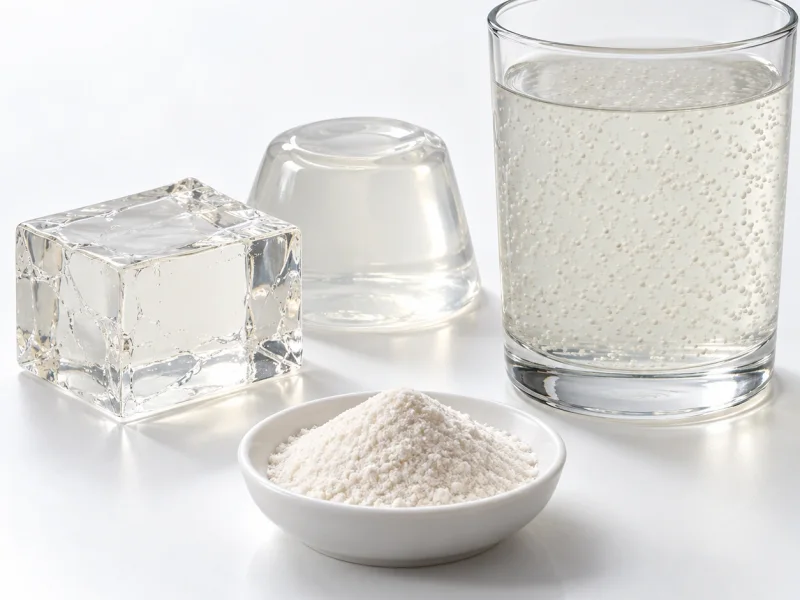
Gellan gum is a fermentation-derived hydrocolloid used to build gels, stabilize food systems, and keep particles suspended. Its most important feature is that it can form structured networks at very low concentrations, and its behavior changes substantially depending on whether the ingredient is high-acyl or low-acyl and on the ions, temperature, pH, and other ingredients around it.
This guide focuses on gellan gum as a food-system ingredient: how grade, ions, processing, and surrounding ingredients change structure, suspension, and texture.
Gellan gum at a glance
| Property | What it means in food |
|---|---|
| Ingredient family | Microbial polysaccharide hydrocolloid |
| Production | Made by fermentation and then recovered, purified, dried, and milled |
| Main functional roles | Gelling, stabilization, suspension, texture control, and thickening |
| Commercial forms | High-acyl (HA) and low-acyl (LA) gellan gum |
| Key formulation variable | Ions such as sodium, potassium, calcium, and magnesium can strongly affect network formation |
| Typical food systems | Beverages, dairy and plant-based drinks, gels, desserts, fillings, sauces, and structured foods |
Although gellan gum is sometimes grouped loosely with “vegetable gums,” it is not extracted from a plant. Commercial gellan gum is produced by microbial fermentation, historically associated with Pseudomonas elodea and now commonly described as Sphingomonas elodea.
Why gellan gum is more than a generic thickener
Calling gellan gum a thickener is technically correct but incomplete.
Many hydrocolloids mainly work by increasing the viscosity of the continuous water phase. Gellan gum can do that, but its distinctive strength is its ability to organize into a three-dimensional network as a hot solution cools. Depending on the grade and formulation, that network may become a firm gel, a soft elastic structure, or a weak fluid-gel network that is strong enough to suspend particles while still pouring easily.
That makes gellan gum useful when a formulator wants structure without simply making a product feel much thicker.
A beverage is a good example. Cocoa, minerals, fruit particles, or other insoluble material naturally tend to settle. A weak gellan network can slow that movement at rest, yet break down readily when the drink is shaken or poured. The result can be physical suspension with relatively little increase in perceived thickness.
High-acyl vs low-acyl gellan gum
The most important distinction within commercial gellan gum is the difference between high-acyl (HA) and low-acyl (LA) grades.
The native fermentation polymer contains acyl substituents. High-acyl gellan retains these groups, while low-acyl gellan is produced by removing most of them during processing. That structural difference changes the way the polymer chains associate and therefore changes the texture of the finished network.
| Property | High-acyl gellan gum | Low-acyl gellan gum |
|---|---|---|
| Acyl groups | Largely retained | Largely removed |
| Typical gel character | Soft, elastic, flexible | Firm, more brittle, often clearer |
| Texture contribution | Supple structure and soft suspension networks | Stronger, more defined gel structure |
| Common formulation role | Suspension, stabilization, elastic texture | Firm gels, clean set, defined structure |
These are useful tendencies, not universal product specifications. Commercial grades can differ, and the final texture also depends on concentration, ions, pH, soluble solids, thermal history, and interactions with other ingredients.
Formulators can also combine high- and low-acyl behavior to tune the balance between firmness and elasticity rather than treating them as two completely separate ingredients.
How gellan gum forms a gel network
Gellan gum is a linear, negatively charged polysaccharide. Its repeating unit contains two glucose residues, one glucuronic acid residue, and one rhamnose residue.
The practical behavior is easier to understand as a sequence:
- Hydration and heating: the polymer is dispersed and hydrated in the water phase under conditions appropriate for the grade and formulation.
- Chain ordering during cooling: as temperature falls, the polymer chains shift from more disordered conformations toward ordered helical structures.
- Association between helices: neighboring helices associate into junction zones.
- Network formation: enough connected junction zones create a continuous three-dimensional structure that can behave as a gel or weak structured fluid.
This is why processing history matters. Gellan gum is not simply “added to make something thick.” Hydration, heating, cooling, and the surrounding ionic environment all influence what structure develops.
Why ions matter so much
Gellan gum carries negatively charged groups along its polymer chain. Positively charged ions can help screen those charges and promote association between ordered chains.
In practical food systems, the amount and type of dissolved salts can therefore change gel strength, setting behavior, and texture. Divalent ions such as calcium can have a particularly strong effect, but sodium, potassium, magnesium, sequestrants, acids, and other formulation components can also alter how the system behaves.
This has an important consequence: the same amount of gellan gum can perform differently in two foods with different mineral or salt profiles.
A formula that works in purified water cannot automatically be expected to behave the same way in a calcium-fortified drink, a dairy system, a plant-protein beverage, or an acidic fruit system.
For that reason, universal dosage rules are poor substitutes for formulation-specific testing.
How gellan gum can suspend particles without making a drink very thick
One of gellan gum's most useful applications is suspension.
A conventional viscosity-building gum slows sedimentation by making the liquid phase more resistant to flow. Gellan gum can take a different route: under suitable conditions it can create a very weak network throughout the liquid.
At rest, this network provides enough structure to restrict the movement of insoluble material. Under pouring, pumping, shaking, or drinking forces, the weak structure is disrupted and the product flows much more freely.
This fluid-gel behavior helps explain why gellan gum is used in products where formulators want to keep components such as cocoa, minerals, or other suspended particles distributed without creating a heavy or excessively viscous mouthfeel.
The important distinction is therefore:
- viscosity control changes how easily the liquid flows;
- structured suspension can create a weak network that resists particle movement even when the product does not feel especially thick.
A formulation may use one or both mechanisms.
Where gellan gum is used in food
Gellan gum can solve different physical problems depending on the food system.
| Food system | Typical functional reason for using gellan gum |
|---|---|
| Plant-based and dairy beverages | Suspends particles and helps reduce settling or separation |
| Fortified drinks | Helps keep insoluble minerals or other particulates distributed |
| Desserts and gelled foods | Creates soft elastic or firmer gel textures depending on the grade |
| Jellies and fillings | Builds defined structure and controls water movement |
| Sauces and fluid foods | Adds body or weak structural stability where needed |
| Structured food systems | Provides a tunable network rather than viscosity alone |
The ingredient is therefore better understood as a structure-building hydrocolloid than as a one-purpose thickener.
Gellan gum vs xanthan gum
Gellan gum and xanthan gum are both fermentation-derived polysaccharides, but they solve formulation problems differently.
Xanthan gum is especially useful for viscosity control and strong shear-thinning behavior. It can help a product resist separation at rest while still pouring easily, but it is not typically selected to create the kind of ion-sensitive gel network associated with gellan gum.
Gellan gum is more strongly associated with network formation, gelation, and low-viscosity suspension systems.
| Question | Gellan gum | Xanthan gum |
|---|---|---|
| Main structural strength | Gel or weak network formation | Viscosity and shear-thinning flow |
| Ion sensitivity | Often central to performance | Usually less central to its basic thickening behavior |
| Firm gel potential | Yes, especially with low-acyl grades | Not its typical primary function on its own |
| Low-viscosity particle suspension | Particularly useful through weak network formation | Can support suspension through viscosity and shear-thinning behavior |
Neither ingredient is universally “better.” The correct choice depends on whether the formulation needs viscosity, a defined gel, elastic structure, particle suspension, or a combination of those effects.
What changes gellan gum performance in a formulation
A gellan gum specification tells you the ingredient identity and grade, but it does not tell you exactly how it will behave in every food.
The most important variables include:
Acyl level
High-acyl and low-acyl grades form different textures, so choosing the wrong grade can change elasticity, brittleness, clarity, and suspension behavior.
Mineral and salt composition
Ions can strongly influence how gellan chains associate. Calcium-fortified systems, dairy minerals, added salts, and sequestrants can therefore change network formation.
pH
Acidic conditions can affect hydration, ion availability, and interactions with other ingredients. The effect should be evaluated in the actual food matrix rather than inferred from a neutral-water test.
Sugar and soluble solids
Sugars and other dissolved solids alter the water environment and can change hydration and gel properties.
Heating and cooling history
Gellan structure develops through hydration and temperature-dependent chain ordering. Processing temperature, hold time, shear, and the rate and conditions of cooling can therefore change the result.
Proteins and other hydrocolloids
Gellan gum rarely exists in isolation in a commercial food. Proteins, starches, pectin, carrageenan, xanthan gum, cellulose gums, and other ingredients can change the final rheology and structure.
This is why a useful gellan-gum specification starts with the food system and target texture, not with a universal percentage.
What the ingredient name does not tell you
Seeing “gellan gum” on an ingredient list identifies the hydrocolloid, but it does not reveal the complete formulation strategy.
The name alone usually does not tell you:
- whether the grade is high-acyl or low-acyl;
- the exact concentration used;
- which ions are present or controlling gelation;
- whether the gum is being used mainly for gelation, suspension, stabilization, or texture;
- whether it is combined with another hydrocolloid;
- the supplier-specific grade, particle size, or processing recommendations.
For formulation work, those details matter more than the ingredient name by itself.
The practical takeaway
Gellan gum is best understood as a fermentation-derived network-forming hydrocolloid. Its value comes from the ability to move between soft elastic structures, firm gels, and weak suspension networks depending on acyl level and formulation conditions.
The two questions that matter most are therefore not simply “How much gellan gum should I use?” but:
- Which gellan grade matches the texture or suspension problem?
- What do the ions, pH, temperature history, and other ingredients in this specific food system do to that grade?
Answering those questions is what turns gellan gum from a generic ingredient name into a useful formulation tool.
Sources
- Handbook of Hydrocolloids, 3rd ed. — Gellan gum — structure, high- vs low-acyl behavior, hydration, gelation, ions, and food applications.
- FDA — Substances Added to Food: Gellan Gum — US ingredient identity, CAS number, technical effects, and reference to 21 CFR 172.665.
- Ingredion — Gellan Gum Product Information File — commercial production description and ingredient structure information.
- CP Kelco — Gellan gum formulation applications — commercial food-system context for suspension and stabilization in beverages.
- Foods, 2026 — Gellan Gum Modification and Structural Regulation for Food Applications — current review of structure-function relationships, high- and low-acyl behavior, and formulation variables.